
7 Haircuts for Wavy Hair: Choose by Length, Density, and Routine
A good haircut for wavy hair makes room for your natural bends without removing the weight your ends need. A soft bob, layered lob, relaxed shag, or longer layered cut can all work. The useful question is not which cut creates the most volume, but where you want that volume and how you want to wear it on an ordinary day.
Waves are not uniform. You might have a nearly straight crown, stronger bends underneath, and a front section that turns in a different direction. Fine strands can also be densely packed, while thicker strands can be relatively sparse. Choose the length, layering, and perimeter together rather than asking for a cut based only on a wave-type label.
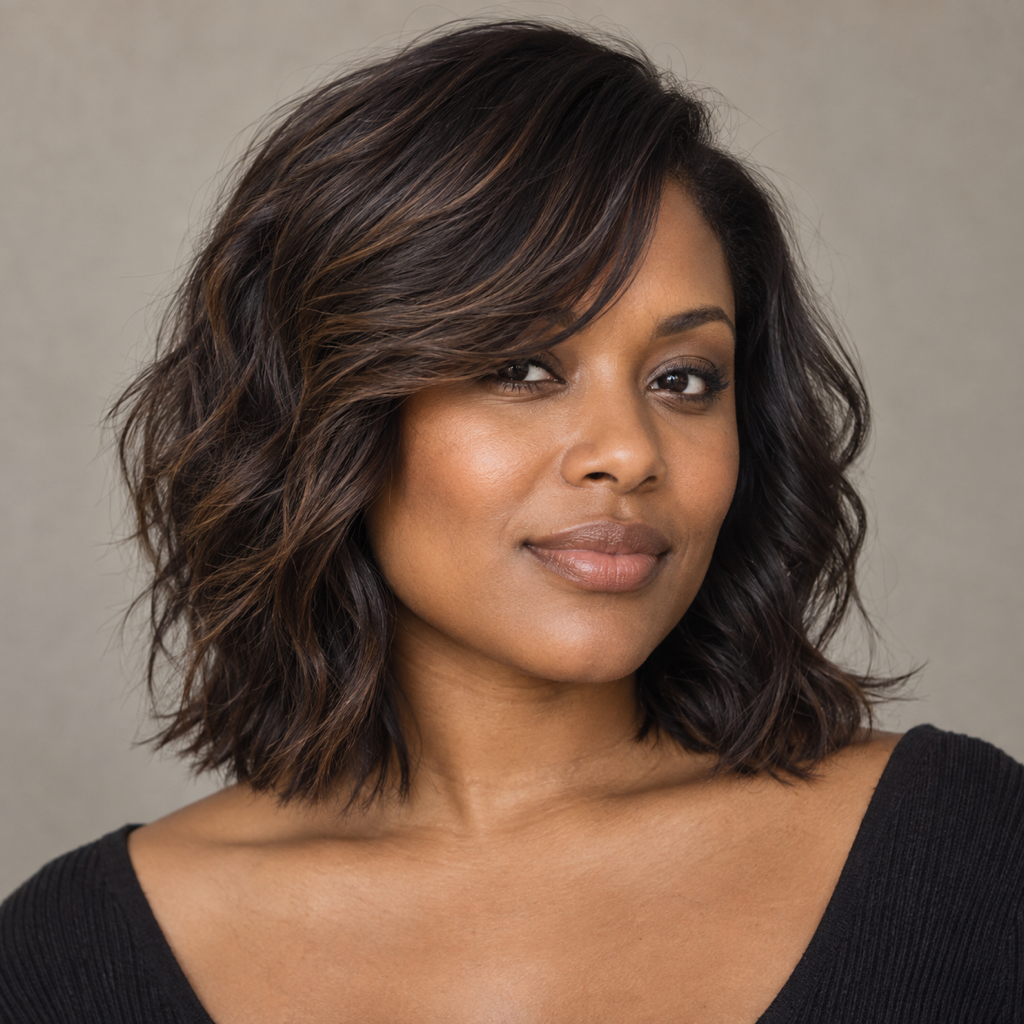
The image above is an illustrative hairstyle reference, not a client before-and-after or a prediction of how your waves will dry.
Start with the way your hair dries
Before you save haircut references, look at your hair after your normal wash and styling routine. Notice four things:
- Where the wave begins. Some hair bends near the roots; other hair needs several inches of length before the first curve appears.
- Where the shape gets widest. A heavy baseline, dense sides, and short layers can create quite different outlines.
- How the ends look. If they separate or appear see-through, removing more weight may not be helpful.
- What happens after sleep. The cut still needs to work when one side is flattened and the front needs a small reset.
Take photos from the front, side, and back. A stylist can use those alongside your inspiration pictures to understand what the cut must work with. Do not arrive with a straightened finish and assume it shows your natural wave pattern.
1. Soft wavy bob
A bob around the jaw or neck puts the wave close to the face and creates a visible outline. A relatively solid perimeter can be useful when you want the ends to look fuller. If the sides are dense, the stylist may need to adjust the interior so the bob does not form a wide block.
Consider it if: You like your natural texture around your cheeks and do not need every section to reach a ponytail.
Ask before cutting: Where will the shortest part finish when dry? A wave that bends outward at the jaw will not behave like the smooth, tucked-under bob in a reference photo. Decide whether you like that movement rather than building a daily straightening job into the cut.
For finer strands, our guide to bob haircuts for fine hair explains the difference between a strong baseline and a heavily layered outline.
2. Collarbone lob with long layers
A lob leaves more length for waves to form than a short bob. Long, connected layers can distribute movement without creating many short pieces at the crown. Keeping the front long also gives you more options for tucking and tying your hair.
Consider it if: You want a noticeable change but still need practical length for work, exercise, or a clip.
Ask before cutting: Will the ends sit on the shoulders or below them when dry? The shoulder contact point can push a wave outward. That can look intentional, but it is worth planning rather than treating the flip as an unexpected problem later.
3. Mostly one-length cut for fine or lower-density waves
Layering is not compulsory for wavy hair. A mostly one-length shape can preserve a clear edge when individual strands are fine or the ends have low density. Small changes around the face can add movement without spreading the remaining hair across many lengths.
Consider it if: Your main frustration is separated ends rather than too much width or weight.
Ask before cutting: Can we improve the outline before adding more layers? Fine hair describes strand diameter; low density describes how much hair you have. Explain both. Our best hairstyles for fine hair guide covers that distinction and other options for keeping the perimeter visible.
4. Rounded medium cut for dense waves
If the bottom of your hair feels much wider than the top, a rounded medium shape may distribute the outline more evenly. The goal is to place movement around the head, not simply to thin the ends until they look light.
Consider it if: You have substantial density, like visible volume, and want the silhouette to feel more balanced from the side and back.
Ask before cutting: Which sections need shaping, and which need to keep their weight? Ask the stylist to explain any thinning or texturizing they propose. The technique should suit your strand texture and the way your waves group together.
5. Relaxed shag
A shag creates more contrast between shorter upper layers and the longer perimeter. That can bring texture closer to the face and make an intentionally uneven outline part of the style. It also means accepting that some pieces will not tuck or tie back.
Consider it if: You enjoy a tousled shape, your waves already have movement, and you are comfortable refreshing individual sections.
Ask before cutting: How short will the crown and face framing be? A heavily layered shag is not automatically low maintenance. If your wave is loose or the ends are sparse, a softer version with longer layers may be easier to live with than an extreme reference.
6. Long layers with a restrained face frame
Keeping length can preserve the flowing shape of looser waves. Long layers add some separation without placing every bend close to the crown. A face frame can start around the jaw or below, depending on how much hair you want to pull out of the main perimeter.
Consider it if: You like long hair and mainly want to change how it moves, rather than remove a large amount of length.
Ask before cutting: Will shorter layers actually help my wave pattern, or interrupt it? In a consultation for fine, naturally wavy hair, licensed hairstylist Bill Angst recommends very long layers for that reader instead of assuming shorter is easier. It is an individual example, not a rule for everyone, but a useful reminder to match the cut to the hair.
7. Wavy bixie with a longer top
A bixie sits between a bob and a pixie, often keeping some length through the top and sides while shortening the nape. On wavy hair, that can create a compact shape with visible movement rather than a smooth, close crop.
Consider it if: You want genuinely shorter hair and are happy to trade ponytail length for a more defined outline.
Ask before cutting: Is there enough length left for my wave to bend? Cutting below the length where a loose wave forms can change its appearance. Discuss your crown, cowlicks, fringe direction, trim schedule, and the shape you would grow into next.
Should wavy hair be layered?
Sometimes. Layers can redistribute weight and change where waves sit, but more layers do not guarantee better definition. The decision depends on the problem you are trying to solve.
- Too much width at the ends: Ask about shaping the interior and connecting the layers.
- Thin-looking ends: Keep a stronger perimeter and be cautious about removing more weight.
- Flat upper sections: Discuss whether shorter layers would help your particular pattern or just create shorter straight pieces.
- Different textures around the head: Ask for those sections to be assessed separately rather than cut to an identical formula.
A haircut does not turn every loose wave into a curl. References made with a curling iron can be useful for discussing a shape, but they should not be presented as an air-dry result.
Build a realistic styling plan
Tell your stylist whether you air-dry, diffuse, or blow-dry. Also say whether you use a hold product and how often you refresh your hair. A cut designed around a salon blowout may feel very different when left alone at home.
If you want to air-dry, ask to see the shape with as little extra manipulation as possible. If you prefer diffusing, ask how to preserve the silhouette without needing to recreate every curl in the reference. The aim is a repeatable routine, not a promise that a haircut eliminates styling.
For grow-out, discuss which areas change first. A short nape or fringe can need attention sooner than long, connected layers. Keeping more length around the face may give you a simpler route to clips, tucks, or a ponytail between appointments.
Preview two lengths before choosing one
Compare a bob and a lob, or a lob and long layers, before changing length, fringe, and color at the same time. Naee lets you explore hairstyle directions on your own photo, which can help you decide how much of your jaw, neck, and shoulders you want to show.
A generated preview cannot predict your wave pattern, shrinkage, density, or daily styling result. Save the silhouettes you like and ask a stylist which details are achievable with your actual hair. The hairstyles by face shape guide can help you describe the proportions you prefer without treating any face shape as a restriction.
Download Naee for iPhone (free download, in-app purchases) →
FAQ
What is the best low-maintenance haircut for wavy hair?
The one that suits how your hair already dries. A lob or long layers may preserve useful weight and tying-back options, while a bob can be practical if you like its natural bends and do not need a ponytail. Ask what styling the reference requires before deciding.
Can wavy hair look good without layers?
Yes. A mostly one-length cut can give fine or low-density waves a stronger-looking perimeter. Dense waves may benefit from selective shaping, but that does not mean everyone needs short or highly visible layers.
Should wavy hair be cut wet or dry?
Both methods can be useful. What matters is that the stylist understands how your hair changes as it dries and checks the finished outline in the way you normally wear it. Ask how they account for uneven wave patterns and dry-length changes.
Will cutting my hair shorter make it wavier?
Not predictably. Removing weight may change how some waves sit, but a loose pattern may need length to form a full bend. Choose the shorter silhouette because you like it, not because it promises a particular wave pattern.
What should I bring to a haircut consultation?
Bring photos of your normal hair, two or three references with comparable texture, and your non-negotiables: ponytail length, time spent styling, fringe preferences, and trim budget. Explain what you dislike about the current shape so the stylist can address the cause rather than simply remove length.