
Curly Bob Haircuts: Choose Your Dry Length and Shape
Choose curly bob haircuts by where your normally worn dry curls should finish, then decide whether you want a rounded, longer-front or more lightly layered outline. A curl-experienced stylist should assess your actual curl behavior, density and cutting method. A wet endpoint, a curl-type label or an AI image cannot settle those questions for you.
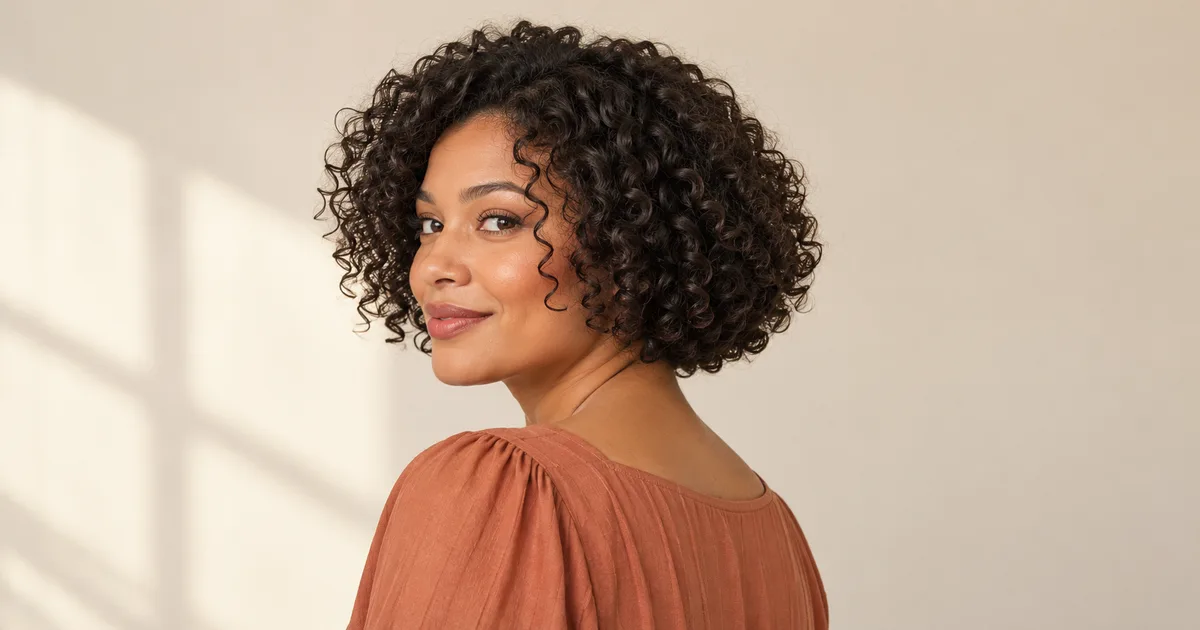
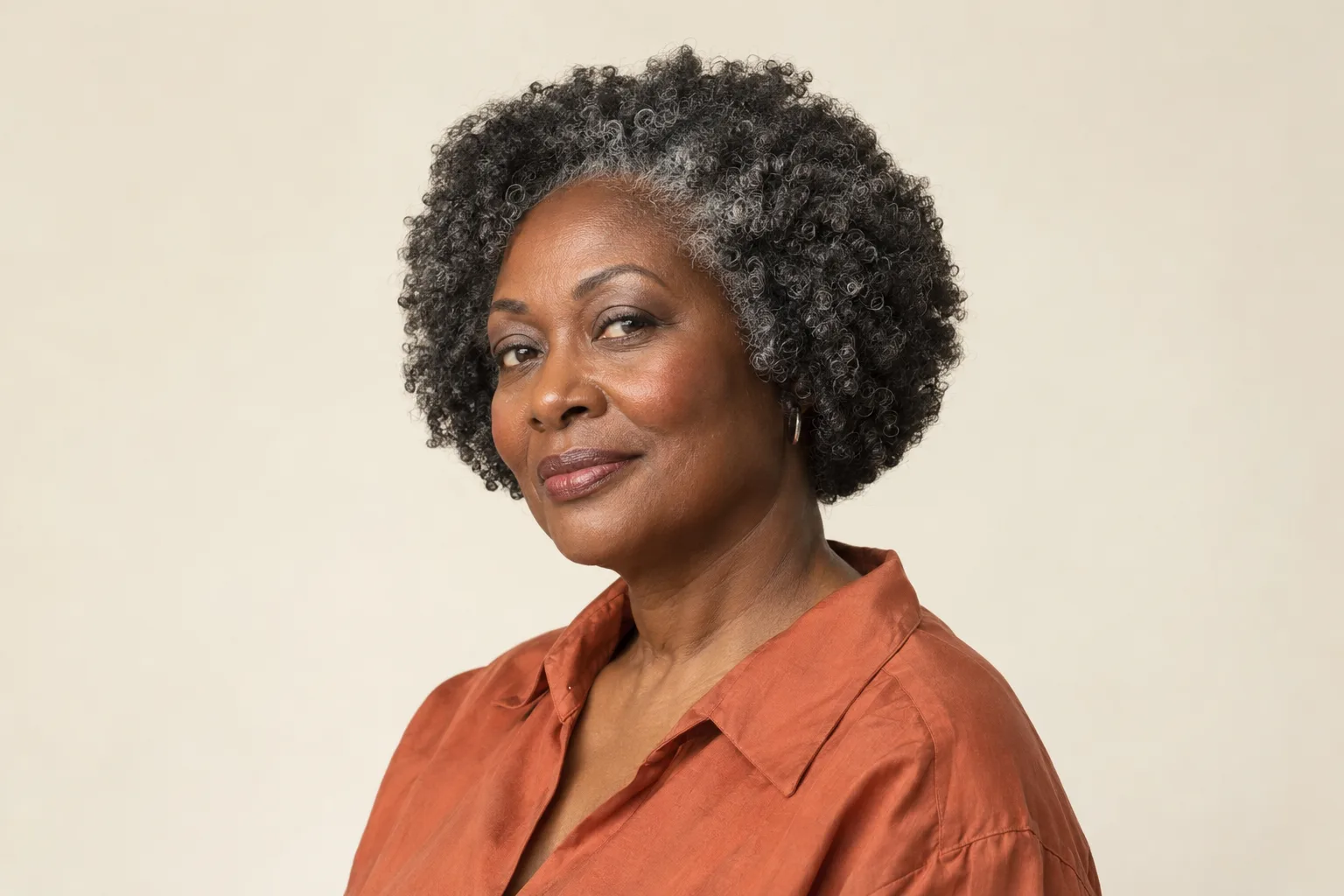
Generated editorial illustration of a rounded curly bob, not Naee output, a real client transformation or a promise of how your hair will dry.
The useful starting point is not “Can curly hair have a bob?” It is “Which parts of this bob do I want, and what would my own curls need to do to create them?” A chin bob, a below-chin bob and a collarbone lob all leave different room for curl formation, fastening and styling. The photographs below are original generated references, not evidence that one texture will behave like another.
Contents
- Choose your dry endpoint first
- Compare curly bob haircuts by outline
- Adapt the reference to your curls and ends
- Discuss wet and dry cutting without a universal rule
- Bring a specific curl consultation checklist
- Use a preview only to explore a direction
- FAQ
Choose your dry endpoint first
A curly strand travels around bends or spirals. Its tip can sit much closer to the scalp than the same strand does when elongated. That is why the visible hanging length is not the same thing as the length along the strand. As damp curls dry and settle into their usual pattern, the endpoint can rise without hair having been cut off.
Water, product, handling and drying method affect how the curls sit. Removing length also changes the weight pulling on them. In Harper’s Bazaar’s stylist interview about curly bobs, Hershesons stylist Conor McLaughlin explains that shorter lengths can show texture differently because less weight is pulling it down. That does not mean every curl becomes tighter by a predictable amount after a bob cut.
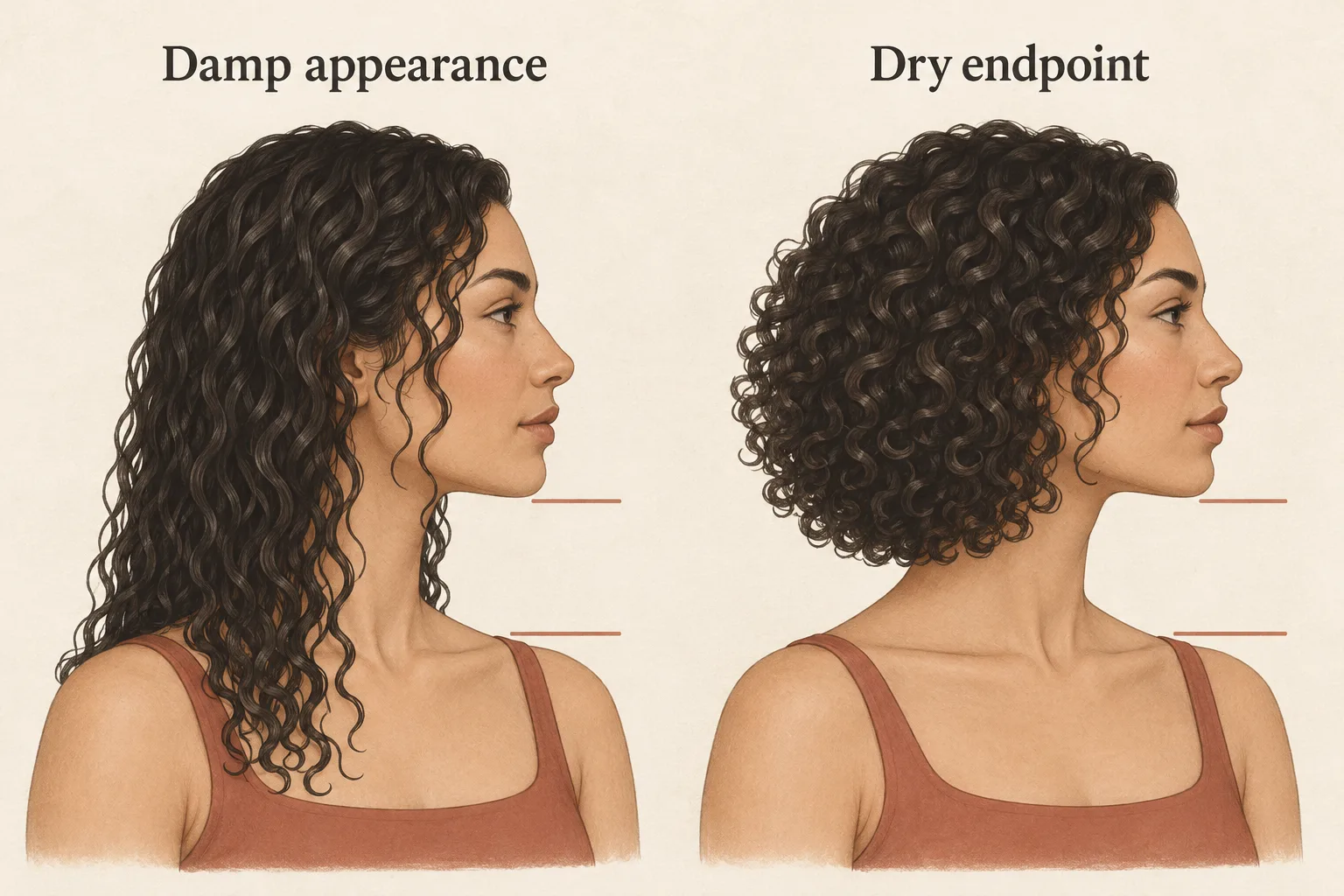
Generated editorial diagram, not an actual wet-to-dry comparison. The difference is conceptual and unmeasured; it does not predict anyone’s shrinkage.
Point to a landmark on your face or body: the chin, the space below the jaw, the neck or the collarbone. Say whether you mean the front curls, the longest perimeter or the whole outline. “Chin length” can otherwise mean a front curl near the chin while the back sits higher and the sides spring up unevenly.
A useful request is: “I want the front to finish below my chin when I wear my usual dry curls. Please assess the shorter sections before we agree on how much to remove.” Your stylist can discuss whether retaining more length or cutting in stages is appropriate. There is no fixed extra inch or percentage that safely accounts for every head of curls.
Below-chin bob: a little more room around the face
A dry endpoint between the chin and shoulders retains more visible length than a compact chin bob. It may be a comfortable starting direction if you want curls around the jaw without the shortest possible outline. It still does not guarantee a ponytail or a tuck behind the ears: the front and lower sections need to be checked individually.
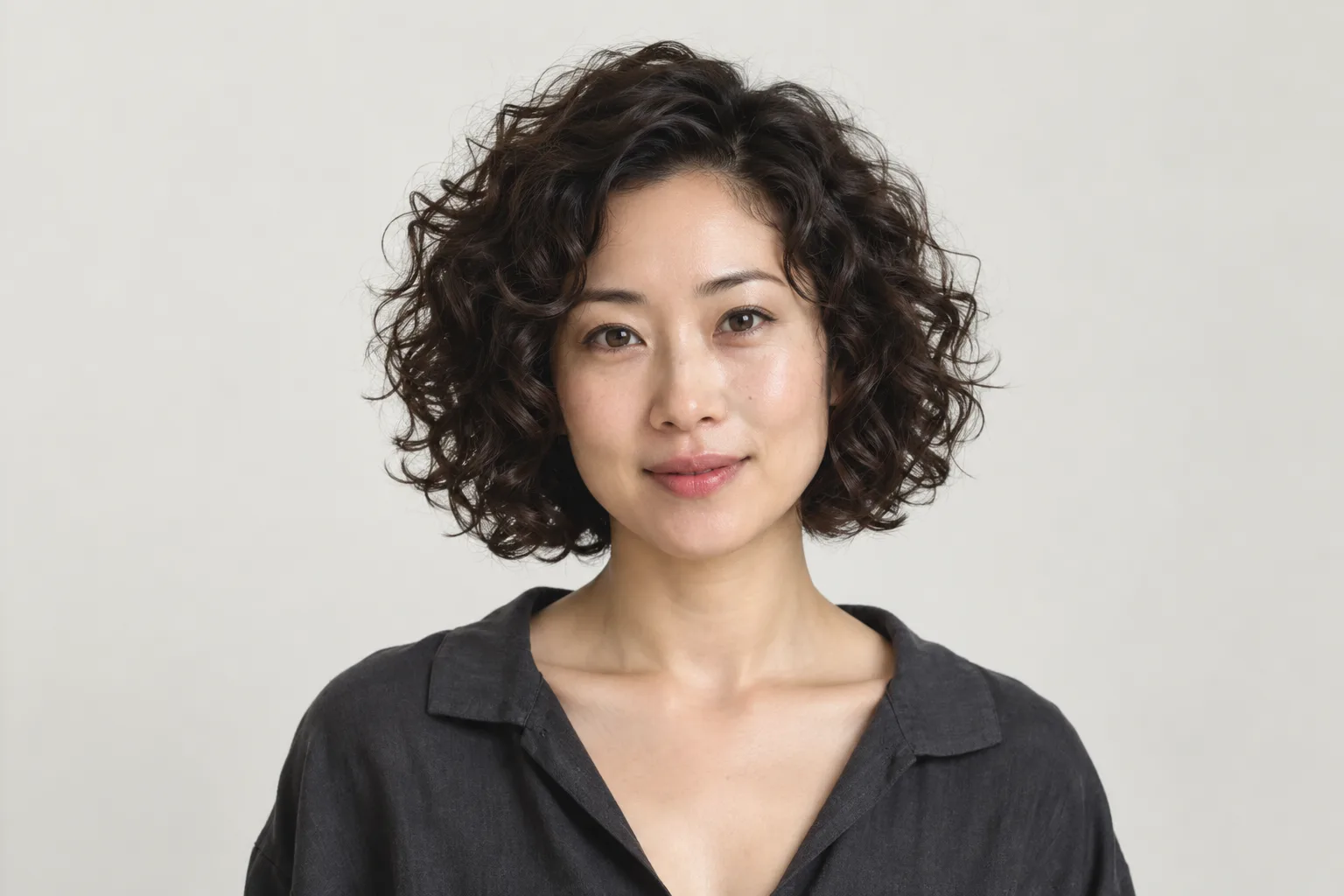
Generated editorial illustration of a below-chin endpoint, not an actual haircut result or Naee preview.
Ask how the nape and front would balance when dry. If your front curls are tighter than those at the back, a visually even dry outline may require different strand lengths. A photograph shows the desired silhouette, not the cutting map needed to achieve it.
Collarbone bob or lob: keep the endpoint longer
A collarbone direction leaves more room before the outline becomes short around the face. On tighter curls, reaching that landmark when dry can require considerably more strand length than a smooth reference suggests. Ask what can realistically reach a clip or tie, including the shortest layers, rather than assuming that “lob” means everything will fasten.
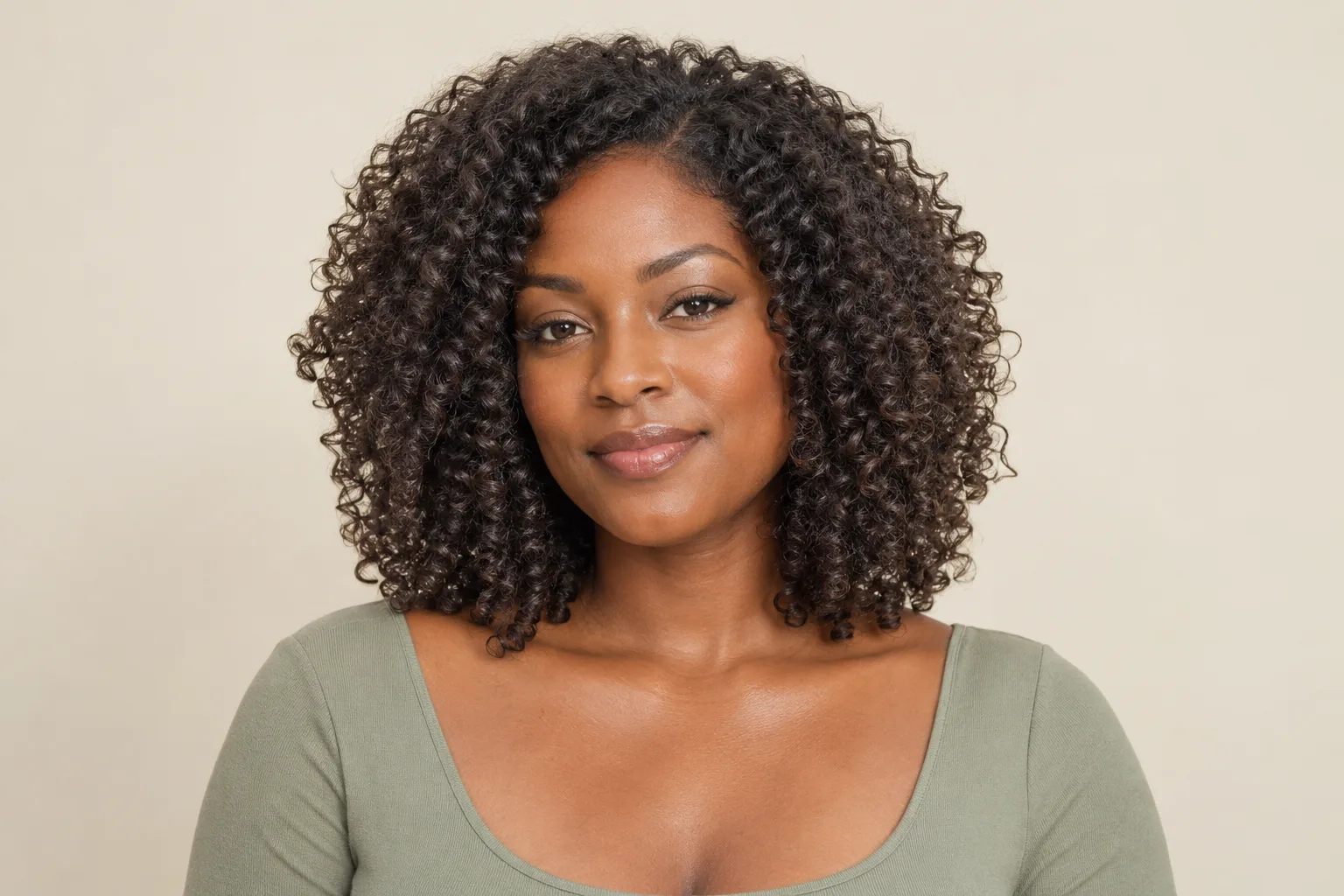
Generated editorial illustration of a longer bob on tighter curls. It is not a measured length conversion or evidence of a real transformation.
The shoulder contact point can alter the way ends sit. Check whether you like curls resting on the shoulders or prefer the perimeter to clear them. Longer hair also takes time to detangle and dry; retaining length is not automatically the easier routine.
Compare curly bob haircuts by outline
The endpoint and the outline are separate decisions. Two bobs can end near the chin while placing their widest point in different places. Layers distribute hair across lengths; the perimeter is the outside edge you see. A rounded appearance does not necessarily require removing large amounts of hair from every section.
| Direction | What to notice in the reference | What to ask your stylist | Practical limit |
|---|---|---|---|
| Rounded chin bob | Curved sides and a compact dry edge | Where will the widest point sit on my usual curls? | Short sections may not tuck or tie |
| Below-chin bob | Extra space between the jaw and ends | Can we keep this endpoint without a heavy lower outline? | A length label does not describe the back |
| Longer-front bob | A diagonal from shorter back to longer front | How will my front curls hold this angle when dry? | Unequal curl patterns can obscure the angle |
| Collarbone lob | Longer perimeter with room for movement | Which sections will actually reach my clip? | Shoulder contact and drying time still matter |
| Curly fringe | Separate curls falling over the forehead | Where will the shortest curl finish after my normal drying? | The fringe may need its own refresh |
| Asymmetric bob | Different dry endpoints on each side | Will this difference remain visible with my normal part? | Part changes and grow-out can change the effect |
Rounded chin bob on loose curls
A rounded bob curves around the head instead of forming a flat shelf across the bottom. Loose spirals can create a soft, open perimeter, with small spaces between curl groups. Decide whether you like that separation or want the edge to look more connected.
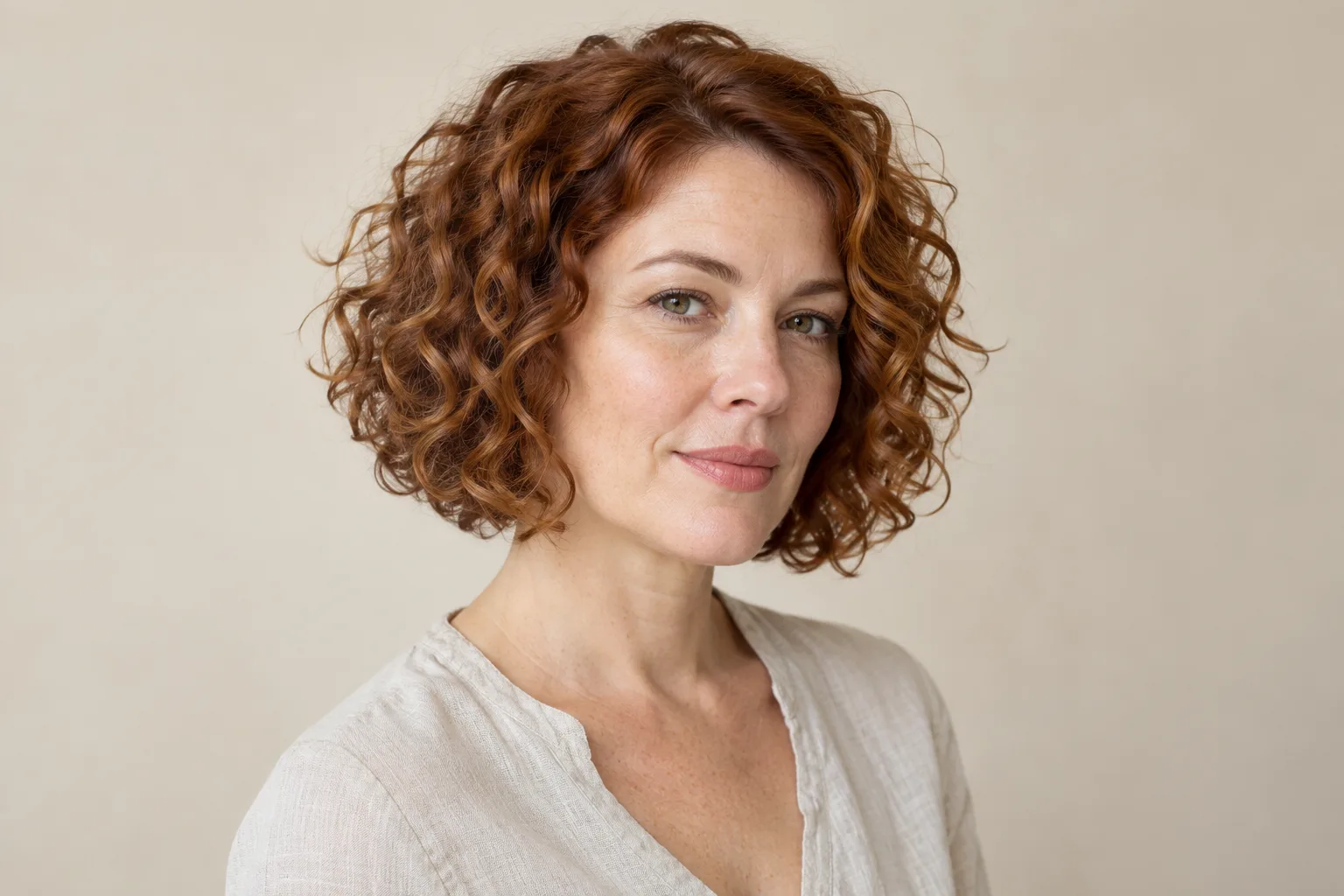
Generated editorial illustration showing a rounded chin bob on loose curls, not a real client or an app result.
Discuss where shaping would move the weight rather than asking to “thin everything.” Removing material from already sparse ends can make the edge less substantial. If your texture is mostly bends rather than spirals, our haircut guide for wavy hair covers how wave formation changes the length decision.
Longer-front shape
A longer-front bob creates a forward diagonal while keeping the back more compact. The front curls need enough retained length to show the intended angle after drying. Ask to see the shape from the side as well as the front; a flattering front photograph can hide a much shorter nape than you want.
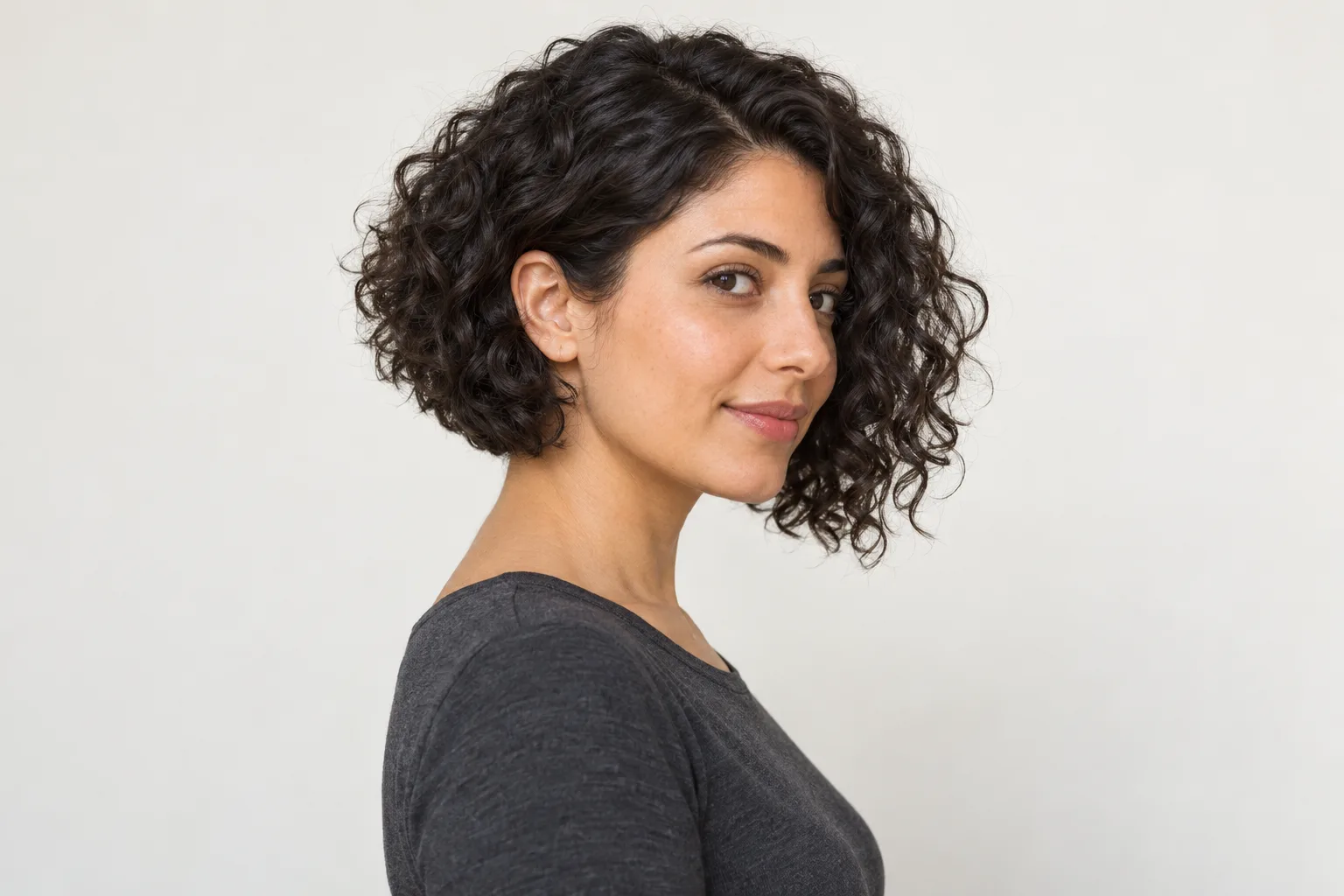
Generated editorial illustration of a longer-front outline, not an actual cut or a guarantee that a diagonal will appear on your curls.
Bring your normal part into the discussion. If you alternate between a center and side part, the front pieces may fall differently. A softly angled shape is not the same request as pronounced stacking or an undercut, so name what you do not want too.
Curly fringe option
A fringe adds a separate endpoint at the forehead. Those shorter curls can behave differently from the bob perimeter, especially if the front pattern is tighter, looser or affected by the way you dry it. Discuss the shortest dry fringe curl, not just the length of a stretched section.
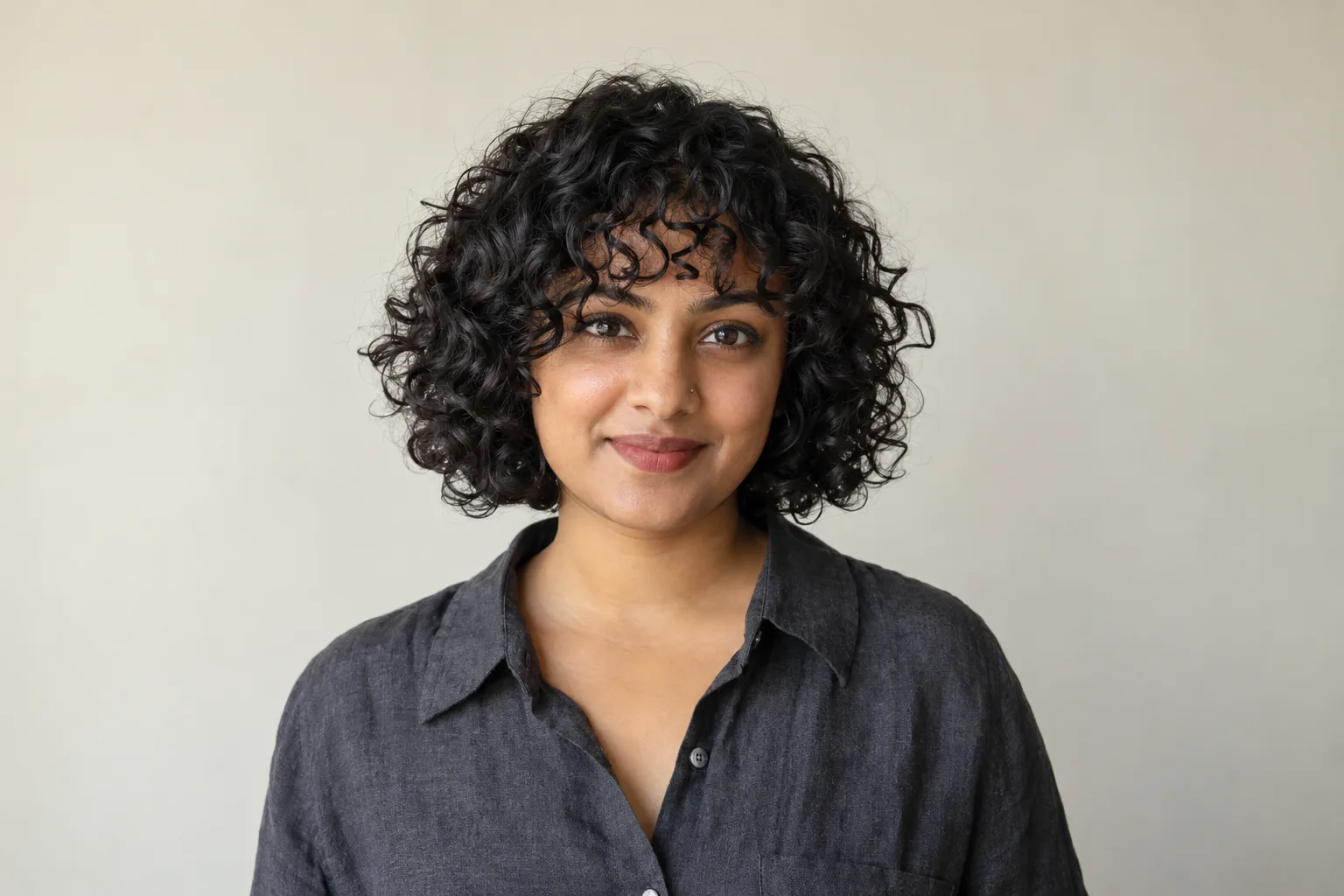
Generated editorial illustration of a curly fringe option, not an actual fringe result or Naee output.
Ask whether you would need to reset the fringe between wash days and what happens if you sweep it aside. Keeping every curl near the brows may require more attention than the rest of the bob. If you do not want a separate styling task, consider face-framing curls that remain long enough to move off the forehead.
Asymmetric outline
An asymmetric bob intentionally puts the two sides at different dry lengths. It is not merely a symmetrical bob with one side tucked away. Choose which side should be longer and whether the difference should look subtle or pronounced on your everyday part.
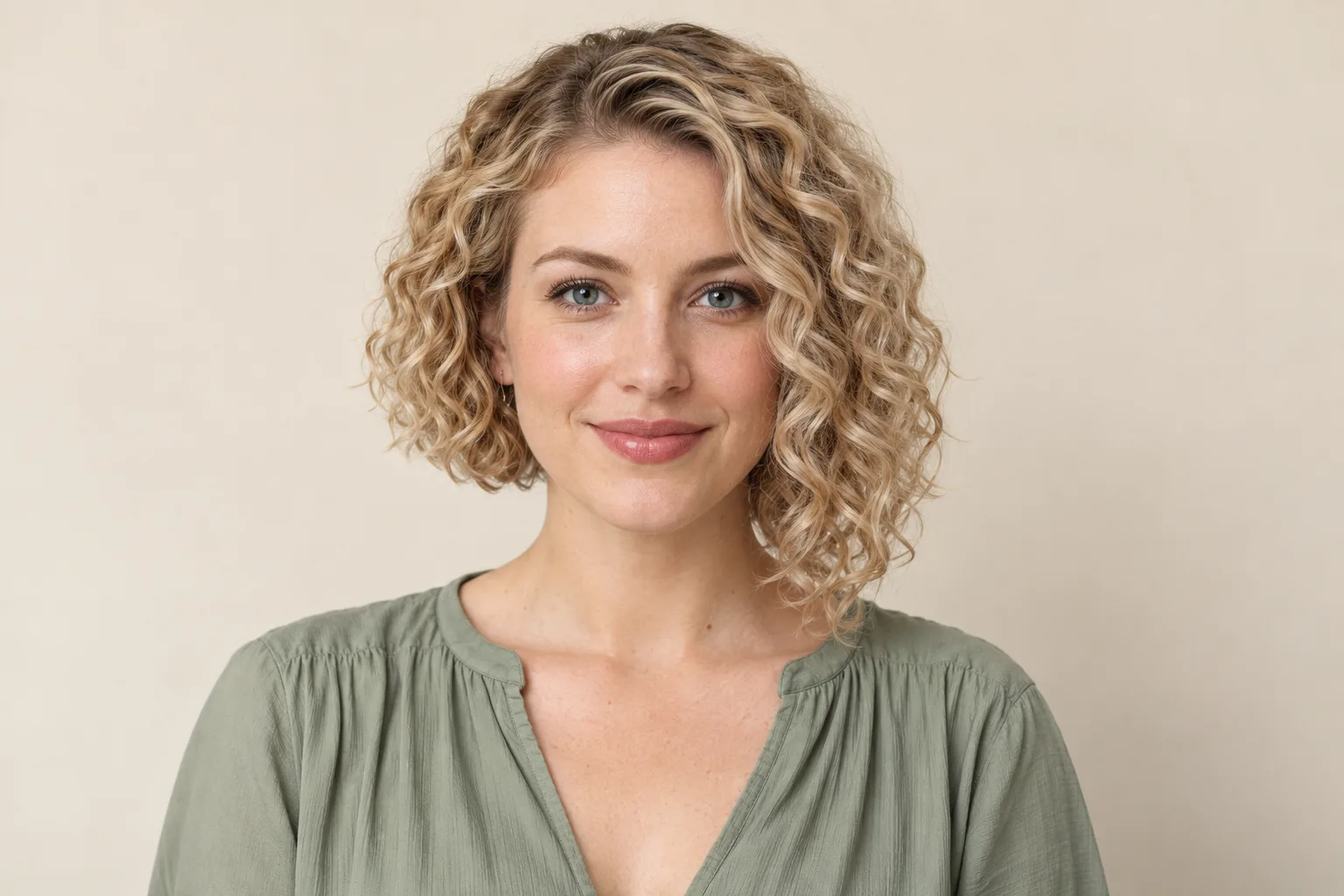
Generated editorial illustration of intentional asymmetry, not before-and-after photography or an app preview.
The outline needs to remain understandable when curls shift. Ask how it will look when one side contracts more or when you change the part. A crisp asymmetric line may need more frequent reshaping than a soft rounded silhouette; agree on a maintenance plan instead of assuming all short cuts are simple.
Adapt the reference to your curls and ends
Curl tightness is only part of the decision. Density describes how much hair grows across an area; strand diameter describes how fine or coarse individual hairs are. Neither can be read reliably from a polished inspiration image. Mixed patterns, curl clumping and the amount of hair left at the ends all affect the same bob outline.
On dense curls, changing some interior lengths may redistribute a heavy lower shape. On ends that already look separated, keeping a more connected perimeter may be the priority. These are consultation possibilities, not universal instructions to layer dense hair or blunt-cut every fine strand. Our bob haircut guide for fine hair explains the perimeter decision without treating fine strands and low density as the same thing.
Generated editorial illustration of a rounded short, bob-adjacent shape on tight coils, not a real client result or a measured texture assessment.
On tightly coiled hair, use this shorter rounded reference to discuss placement of volume, not to demand identical individual curl definition. Ask where the dry sides and nape would finish on your own unstretched hair. A defined wash-day photograph, a picked-out silhouette and a stretched style can show different outlines on the same person.
Do not treat a wider lower shape as a defect by default. If you like that volume, say so. If you prefer a rounder distribution, explain where the width bothers you and ask how the proposed layers would change it. “No triangle” is less informative than “I want less width at the lower sides while keeping these ends connected.”
Discuss wet and dry cutting without a universal rule
Choosing a dry endpoint does not mean the whole haircut must be performed dry. Dry observation helps reveal how your usual curls fall. Wet cutting allows a stylist to work with an elongated structure. Some stylists combine methods, then assess the finished shape. The relevant question is how they account for your texture and check the intended result.
Carol’s Daughter’s curly haircut consultation guide discusses both wet and dry cutting and emphasizes finding a stylist experienced with your curl type. It is a commercial brand source, not a controlled comparison proving that one technique is best. Its consultation advice is useful; its product promotions and treatment claims are not prerequisites for a bob.
Ask these questions before agreeing to the cut:
- “How will you assess the different patterns at my front, crown and nape?”
- “How does your chosen cutting method account for my desired dry endpoint?”
- “Will we discuss the shape after it is dried in a way I normally wear it?”
- “I sometimes wear it stretched or straight. What will that change about the outline?”
Follow the salon’s preparation instructions rather than a universal rule to arrive freshly washed, product-free or fully styled. Tell the stylist what you used and whether your appointment-day texture represents your normal routine. A dry shape check under one finish still cannot guarantee identical curls every morning.
Bring a specific curl consultation checklist
Bring ordinary-day front, side and back photographs as well as a few inspiration images. The ordinary-day photos establish the starting point; the references establish your preference. The consultation should connect those two rather than letting an image substitute for looking at your hair.
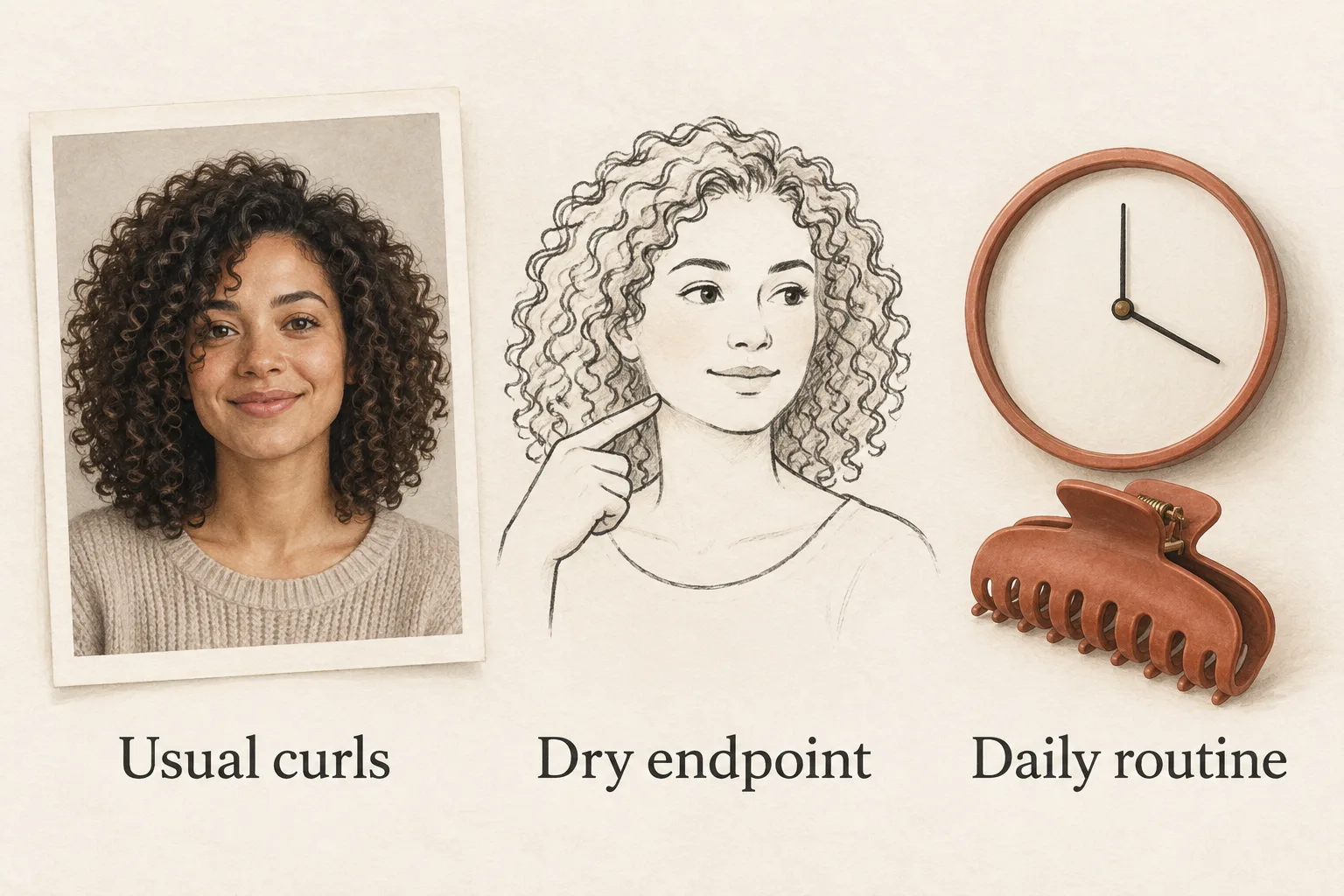
Generated editorial consultation diagram, not app analysis, a salon procedure record or a real person’s results.
Use this accessible checklist alongside the illustration:
- Name the dry landmark: point to the intended front endpoint and describe the back separately.
- Show your normal texture: explain whether the photos show air-drying, diffusing, stretching or a special finish.
- Identify mixed patterns: mention sections that spring up more, flatten after sleep or do not group like the rest.
- Choose the outline: rounded, longer-front, asymmetric or a connected edge with modest layers.
- State fastening needs: demonstrate the clip or tie you use and which pieces must stay out of your face.
- Set a routine limit: describe your actual tools and time, not an ideal routine you will rarely follow.
- Discuss upkeep: ask which parts need refreshing and when the shape is likely to need reassessment.
A hypothetical decision: below-chin or collarbone?
Imagine Nia, a fictional reader with tighter curls at the front and looser curls at the nape. She wants less length but needs to clip her hair away for work. She normally air-dries and does not want a separate daily fringe routine. These are invented planning constraints, not a client case or a Naee test.
Her first reference is a rounded chin bob. She likes the curved outline, but her shortest front curls may no longer reach the clip. Her second is a collarbone lob with a similar rounded distribution. She brings both and says: “I like the first picture’s shape, but keeping these front pieces in my work clip matters more than reaching the chin.”
That gives the stylist a clear priority: retain useful front length, assess the dry back and sides, and discuss whether a longer rounded outline can satisfy the goal. The answer might not copy either photograph exactly. That is an adaptation, not a failed attempt to reproduce someone else’s curls.
The common mistakes are choosing from a wet measurement alone, requesting more layers without naming where you want the volume, and equating shorter hair with less work. A bob may reduce the amount of hair you handle while still requiring careful drying, curl refreshing or more regular shape maintenance.
Use a preview only to explore a direction
If you are deciding between two silhouettes, an own-photo preview can help you notice which length idea you prefer. It cannot measure your shrinkage, establish density, select a cutting method or predict your ordinary-day curl pattern. Keep your real curl photographs beside any generated candidate.
Publisher disclosure: This is the Naee blog, and we have a commercial interest in Naee. We have not conducted an independent curl-fidelity or density benchmark. The official Naee App Store listing describes own-photo hairstyle previews, including curly styles, and Stylist Mode. These are publisher feature descriptions, not proof of salon feasibility.
For a controlled comparison, request only a length or outline change first. Do not simultaneously add a fringe, change color and increase volume. Our guide to using a hairstyle reference photo explains how to separate the cut from the pictured styling. Apply the face-preservation checklist too, since an altered face changes how you judge the hair.
If that kind of exploration would help, you can download Naee for iPhone. It is a free download with limited trial credits and in-app purchases; check the current offer before planning many generations. Bring a favorite as a labeled idea, not as an instruction to make your real curls match generated pixels.
Your next step: choose a desired dry landmark, save two useful outline references and write down one routine requirement you will not compromise. Those three decisions make a more actionable salon brief than a long album of attractive curly bobs.
FAQ
How short should a curly bob be?
Choose the endpoint on your normally worn dry curls, not an arbitrary stretched length. Chin, below-chin and collarbone directions are all possible discussion points. Ask a curl-experienced stylist to assess the front, back and mixed patterns, particularly if you need enough length to tuck or clip sections away.
Does curly hair have to be cut dry for a bob?
No. Dry assessment can show the current curl pattern, but a skilled stylist may use wet cutting, dry cutting or a combination. Ask how the technique accounts for the dry result and how the finished outline will be assessed in your usual style.
How much extra length should I leave for shrinkage?
There is no universal amount. Curl pattern varies between people and across one head, while handling and drying change the visible endpoint. Show how your own hair looks normally dry and discuss retaining length or shortening in stages. The conceptual illustration above supplies no measurement.
Does every curly bob need lots of layers?
No. Layers can redistribute weight and movement, but removing material can also leave a sparse perimeter. Ask which sections need shaping and which need to keep length. A rounded outline is a visual goal, not a requirement to heavily layer every curl type.
Is a curly bob low-maintenance?
It can reduce some handling, but that is not an effortless-maintenance guarantee. Your cut may still need drying time, curl refreshing, fringe attention or shape upkeep. Discuss a finish you can actually repeat and ask how the outline will behave between appointments.