
Face-Shape Apps: Advice or Just Hair Filters?
Recommendation and visualization solve different problems. If you want an app that suggests haircuts rather than simply putting hair on your selfie, look for explained suggestions alongside own-photo previews. An AI hairstyle face-shape label is only a starting point: add your natural texture, what you know about your hair's fullness, daily routine, and personal preferences before choosing a cut.
Naee is one option whose official listing describes both face-shape suggestions and a conversational Stylist Mode. That makes it relevant to this question, not proof that its advice is the most accurate or that a generated hairstyle will work on your real hair.
Publisher disclosure: This is the Naee blog. We have a commercial interest in Naee. This article explains its documented capabilities and a decision method, not an independent hands-on ranking or a clinical assessment of facial analysis. Product sources were checked on October 4, 2026.
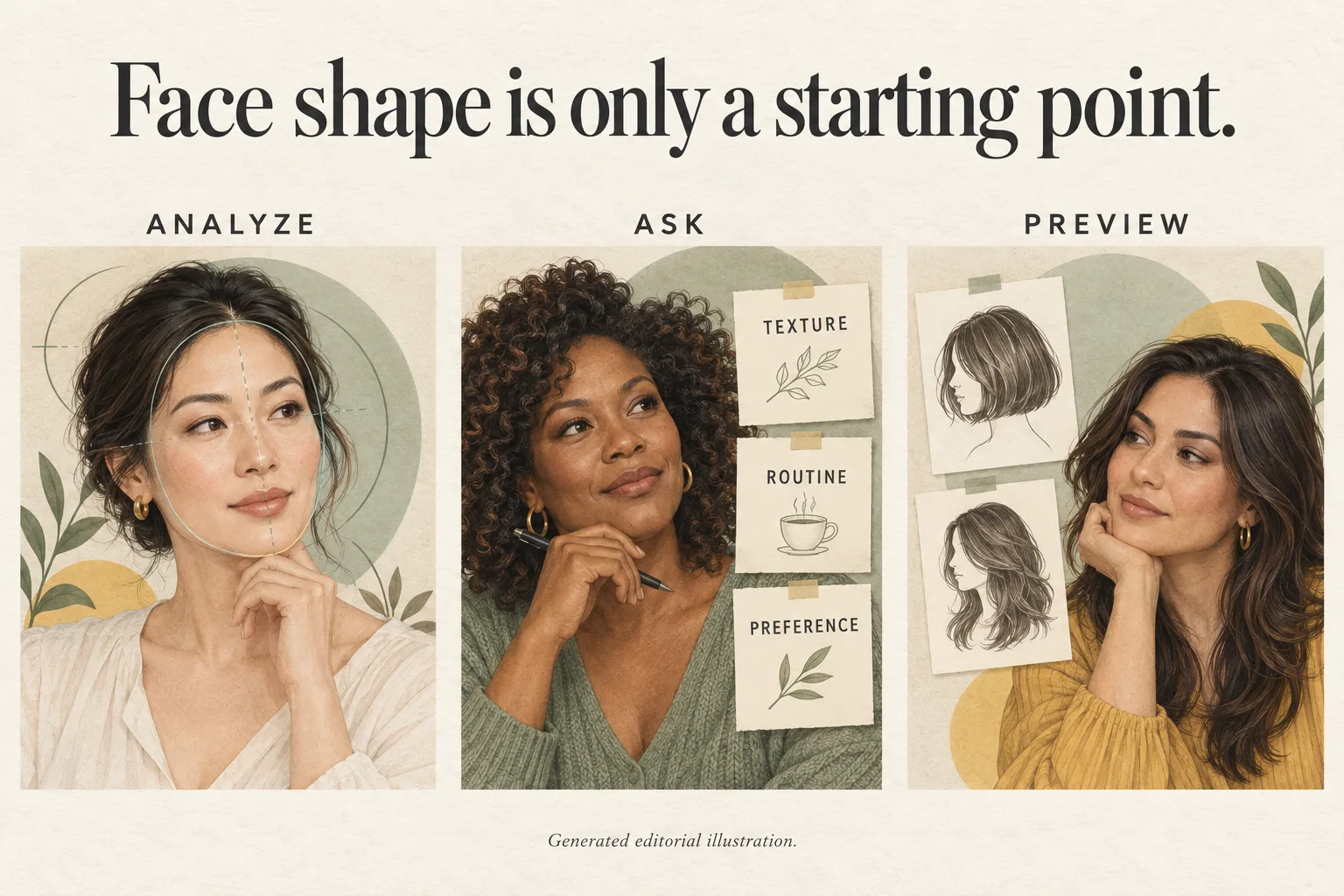
Generated editorial illustration, not a Naee screenshot, actual app output, or evidence of recommendation accuracy.
Table of Contents
- Face-shape apps do three different jobs
- What Naee documents, and what that does not prove
- Give an AI stylist a useful brief
- A hypothetical shortlist that changes with the routine
- Judge advice separately from the generated image
- Why face shape cannot decide your haircut
- Take a better question to the salon
- FAQ
Face-shape apps do three different jobs
A convincing image can make a weak recommendation look authoritative. Avoid that confusion by separating three capabilities when reading an app listing or trying a tool.
Facial analysis describes proportions. It might label a face as round or oval, or describe a jawline and forehead. That is information about the photo, not a complete haircut brief. A result that sounds precise still needs a useful explanation of how it affects the suggested style.
Recommendation proposes a choice and gives reasons. Useful advice connects the cut to your goals and constraints: keeping enough length to tie back, avoiding a fringe that needs daily heat styling, or preserving the texture you enjoy. It should be possible to ask, “Why this cut rather than the other one?” and get an answer beyond “It suits your face shape.”
Rendering creates a visual idea. A hair filter, overlay, or generative try-on can illustrate length, outline, parting, and color. That is valuable even without analysis. But the image alone cannot tell you whether your hair will settle into that shape after washing, whether the fringe needs a round brush, or whether the cut can be achieved from your current length.
| Capability | What to look for | What it cannot establish alone |
|---|---|---|
| Face analysis | A description of facial proportions with understandable language | Your preferred look or a guaranteed flattering cut |
| Recommendation | Reasons linked to texture, routine, preferences, and constraints | Salon feasibility without inspecting your hair |
| Image try-on | A preview on your own photo that is easy to compare with the original | Daily maintenance or an exact finished result |
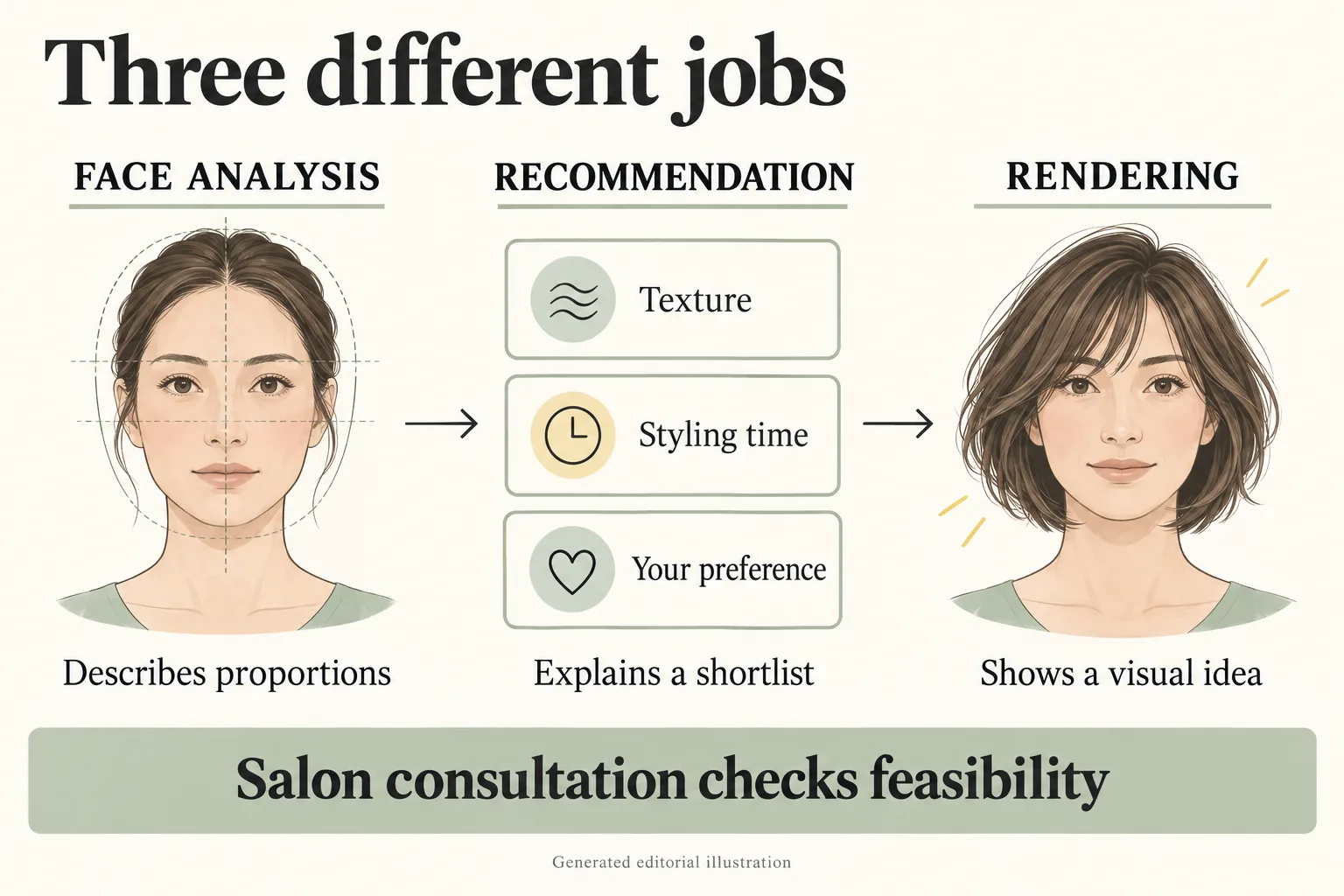
Generated editorial diagram. These are separate tasks, not a verified description of an app's internal architecture.
Choose the tool for the missing job. If you already know you want a shoulder-length bob, a preview may be enough to explore its silhouette. If you have no shortlist, ask for reasons and alternatives before spending time generating images. Our AI hairstyle planning guide explains how previews fit into the broader haircut decision.
What Naee documents, and what that does not prove
The current Naee App Store listing describes “Smart Hair Recommendations” based on face shape, own-photo hairstyle and color previews, and “Stylist Mode (Chat with AI).” Its examples include describing a desired hairstyle in words. The developer's response to an April 9 review also describes using conversational refinement and a hairstyle reference.
The official Naee website describes chatting about face shapes, everyday care, and finding a style that feels like you. It also says generating previews and using stylist chat require an internet connection, while saved looks can be viewed offline.
The privacy policy, effective March 16, 2026, describes face-analysis data including face shape, jawline, forehead proportions, and facial balance. It says Google AI Services via Firebase performs analysis and generation, and that analysis results are stored locally on the device. Those are the publisher's statements about processing, not an independent security audit.
Together, these sources document a product that offers more than a library of hair overlays. They do not establish medically validated scores, a verified hair-density detector, a measured compatibility ranking, or superior advice compared with every other app. None of those claims is necessary to use the tool for exploration.
Naee is a free download with in-app purchases. Its listing describes limited trial credits and subscriptions or credit purchases for continued generations. Check the current in-app allowance and purchase screen rather than assuming unlimited free advice or previews. An app may match your feature needs and still not match your budget or willingness to upload a photo.
Give an AI stylist a useful brief
Do not make the app guess your lifestyle from your face. Tell it the facts you can observe and the trade-offs you are willing to make. “What suits me?” is a reasonable opening, but it leaves the most important constraints unstated.
Start with these inputs:
- Natural texture: Describe how your hair behaves when air-dried, not only after a blowout. Mention waves, curls, or areas that behave differently.
- Current length and previous cuts: Say where the hair falls now and name one cut you liked or disliked, with a reason.
- Everyday styling time: Give a real limit, such as ten minutes, and say whether heat tools are part of the routine.
- Functional needs: Include tying hair back, wearing glasses, exercising, headwear, or workplace expectations that matter to you.
- Maintenance tolerance: Say how often you are willing to book a trim or reshape a fringe. Ask the stylist to confirm the actual schedule.
- Personal preference: Describe the feeling you want: bold, soft, minimal, dramatic, familiar, or visibly different.
If fullness is relevant, describe your own experience, such as “My ends look sparse when I add many layers.” Do not treat a photo-based label as a medical measurement of density or ask a hairstyle tool to diagnose hair loss.
Here is a reusable prompt:
I have shoulder-length hair that forms loose waves when air-dried. I spend about ten minutes styling and want to tie it back for work. I like a clear outline but dislike a fringe that needs daily heat styling. Suggest three haircut directions. Explain why each fits these constraints, what maintenance it might require, and what a salon stylist should check. Treat face shape as one consideration, not a rule.
Ask a follow-up before rendering: “Which option needs the least change to my current routine, and what would make it unsuitable?” The answer might expose an assumption you need to correct. If it ignores your tie-back requirement, repeat that constraint instead of accepting an attractive image as compensation.
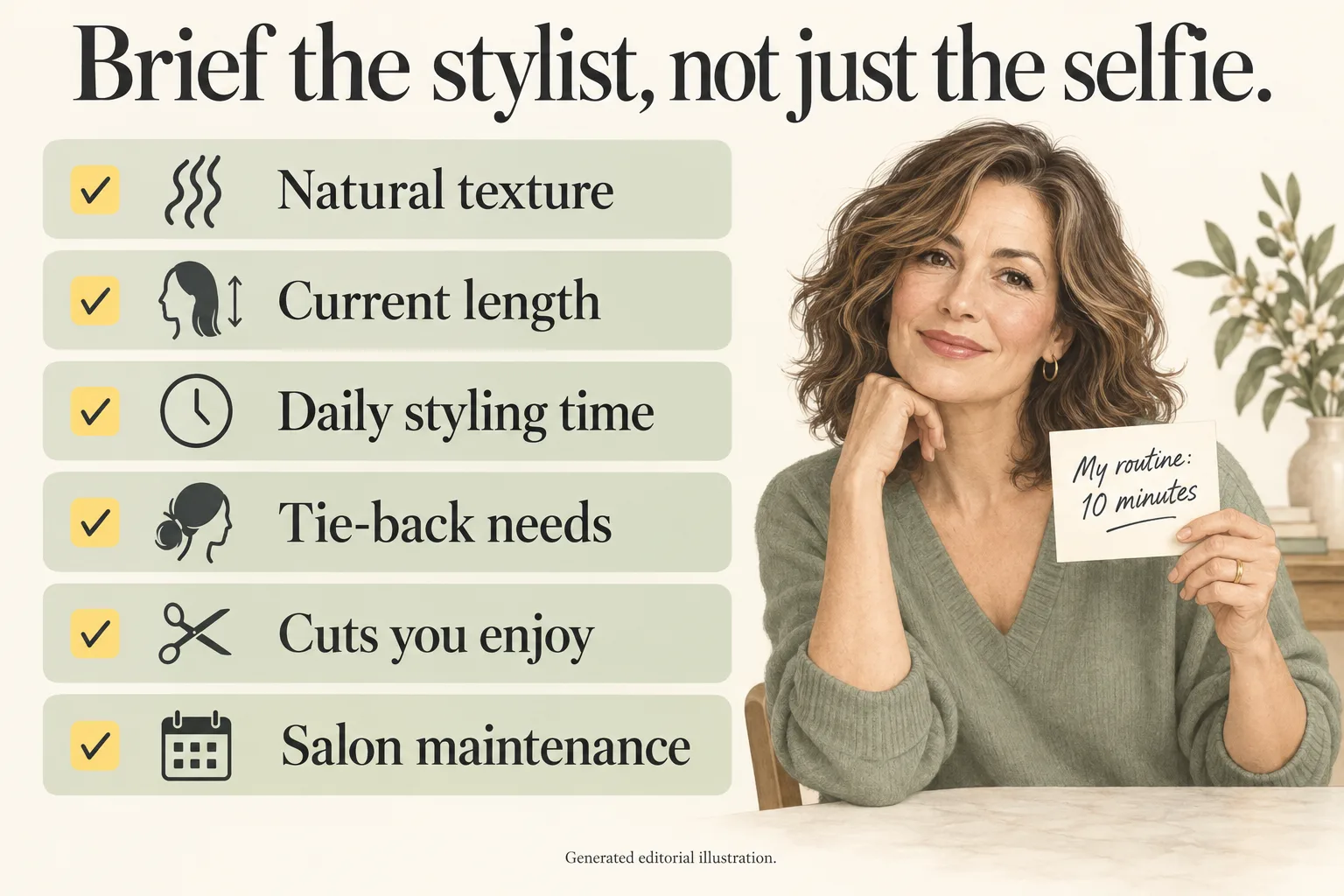
Generated editorial checklist. These are details you supply, not features claimed to be detected from a selfie.
A hypothetical shortlist that changes with the routine
Consider Maya, a hypothetical reader, not a customer case study or a test result. She is 38, has loosely wavy shoulder-length hair, likes showing her jawline, and thinks her face is somewhere between round and oval. She has ten minutes in the morning, wears her hair tied back during work, and does not want to straighten it daily.
A face-shape-only answer might prioritize an elongating silhouette. But Maya has not asked to make her face look longer. Her actual priorities are a visible outline, natural waves, and enough length to tie back. A useful shortlist could compare these directions without claiming that any one is objectively best:
| Hypothetical direction | Reason to investigate | Question for the salon |
|---|---|---|
| Collarbone-length cut with a defined perimeter | Keeps a clear outline while allowing a longer length | Where should the perimeter sit when my waves dry? |
| Shoulder-length cut with restrained face-framing | Adds movement without making a full fringe the main feature | Will these shorter pieces stay back during work? |
| Shorter bob as an exploratory option | Tests whether Maya values a stronger change more than tie-back length | What styling and functional compromises would this require? |
Maya can ask the AI to explain each option, then preview the first two at the same color and from the same photo. Keeping those variables steady makes the length and outline easier to judge. The shorter bob remains an intentional trade-off, not an error merely because it conflicts with a conventional face-shape rule.
Now change one fact: Maya is willing to spend twenty minutes styling and no longer needs a ponytail. That could make a shorter direction worth a closer salon conversation. Her face shape did not change; her shortlist did. That is the distinction between a practical recommendation and a label-driven catalog.
For more questions about natural movement, see our guide to haircuts for wavy hair. Use it to enrich the brief, not to substitute a different set of rigid rules.
Judge advice separately from the generated image
Review the explanation first. Does it mention your actual constraints? Does it name a disadvantage? Does it offer a reasonable alternative? If every option is described as perfect, you have not received much help choosing.
Then inspect the preview against your original photo. Check the jaw outline, forehead, nose, ears, and overall proportions as well as the hair. A changed face can make it harder to assess how a cut relates to your own features.
This is relevant to Naee too. Its current App Store page includes an April 9 review reporting changes to facial features, and a developer response acknowledging the concern and asking for examples to investigate. That is an individual reported experience, not a measured failure rate or proof of the current version's behavior. It is still a reason to inspect your own result rather than assume unchanged-face fidelity.
Use this short decision checklist:
- The explanation reflects my texture and routine.
- I understand at least one compromise for each option.
- The preview remains useful when compared with my original face.
- I am judging the haircut, not only a flattering color or lighting change.
- I can name what I like about the image in ordinary salon language.
- A stylist still needs to assess whether it is achievable on my hair.
A preview that fails the identity check should not settle the decision. Save your original photo and a separate inspiration reference instead. You can still discuss the intended length and shape without treating that rendering as reliable evidence.
Why face shape cannot decide your haircut
Face-shape categories are a convenient vocabulary for talking about proportions. They are not obligations to hide a jawline, slim a face, or create a supposedly ideal outline. You may want to emphasize the very feature another guide tells you to soften.
Our hairstyles-by-face-shape guide offers a starting vocabulary. Use it to articulate a preference, such as wanting width near the cheeks or a more open forehead, rather than to eliminate every cut outside a category.
Texture and routine can change the practical meaning of the same silhouette. Ask a stylist how your hair's movement, growth patterns, and current condition would affect a reference cut. A frontal generated image cannot replace checking the sides, back, and hair in motion, nor does it reveal the styling process behind the look.
The common mistake is to ask, “What is the best haircut for this face?” and treat the first answer as a verdict. A better question is, “Which two or three directions match the effect I want, and what would each cost me in styling effort or lost length?” That keeps the decision yours.
Take a better question to the salon
Your useful output is a small, reasoned shortlist, not a certificate of suitability. Keep two or three images, your original selfie, and a few notes about the features you like. Write down the intended length, perimeter, fringe, and amount of movement so the conversation does not depend on interpreting one image.
Ask the salon stylist which details translate to your hair, which need adapting, and what the cut looks like without a professional blowout. Also ask what happens as it grows out. Those answers connect a visual idea to the haircut you will actually live with.
If you want to explore the documented combination of suggestions and own-photo previews, Naee is available for iPhone on the App Store. Review the current terms and photo-processing policy before deciding whether to use it.
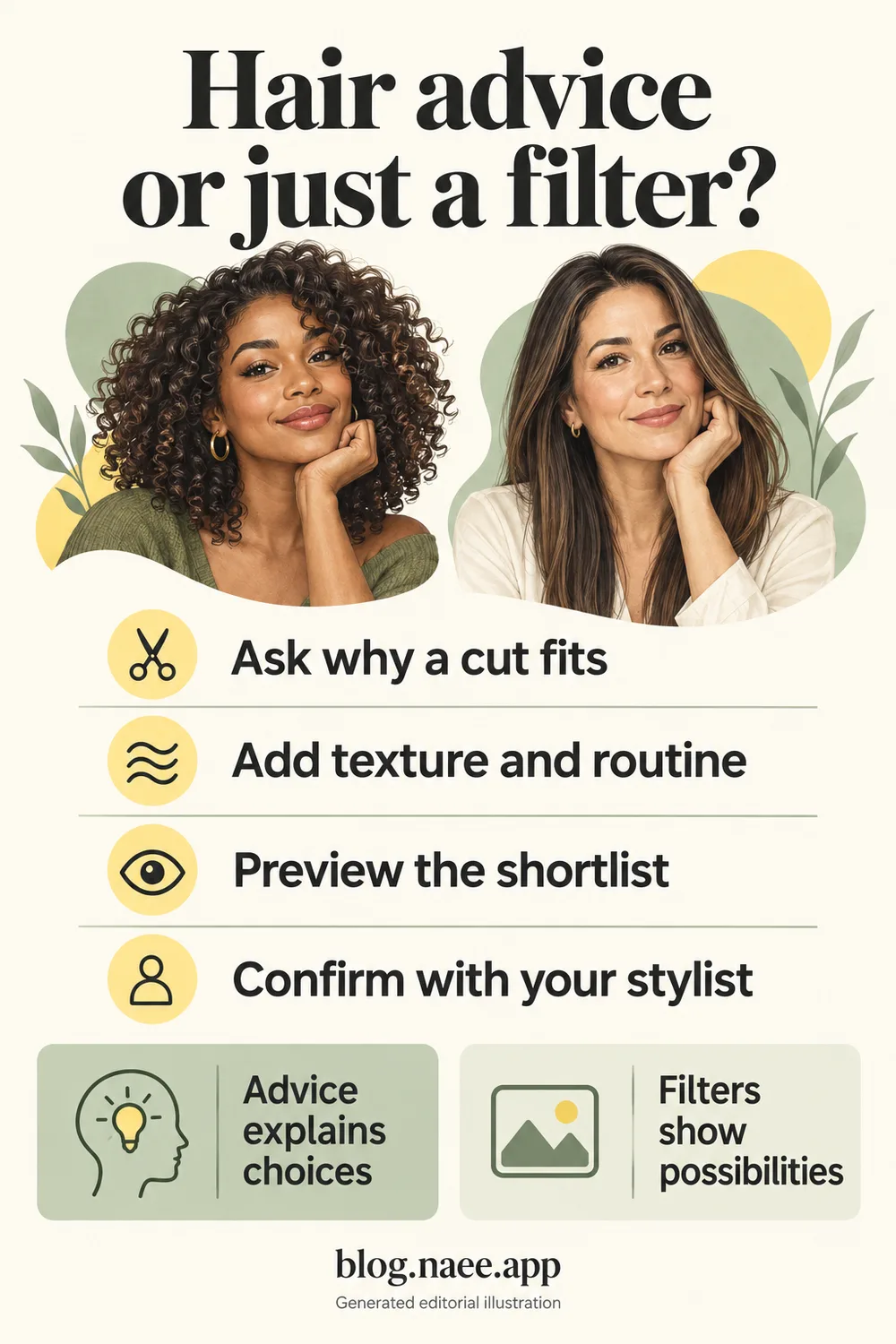
Generated editorial illustration, not app output. Download the full-resolution Pinterest checklist.
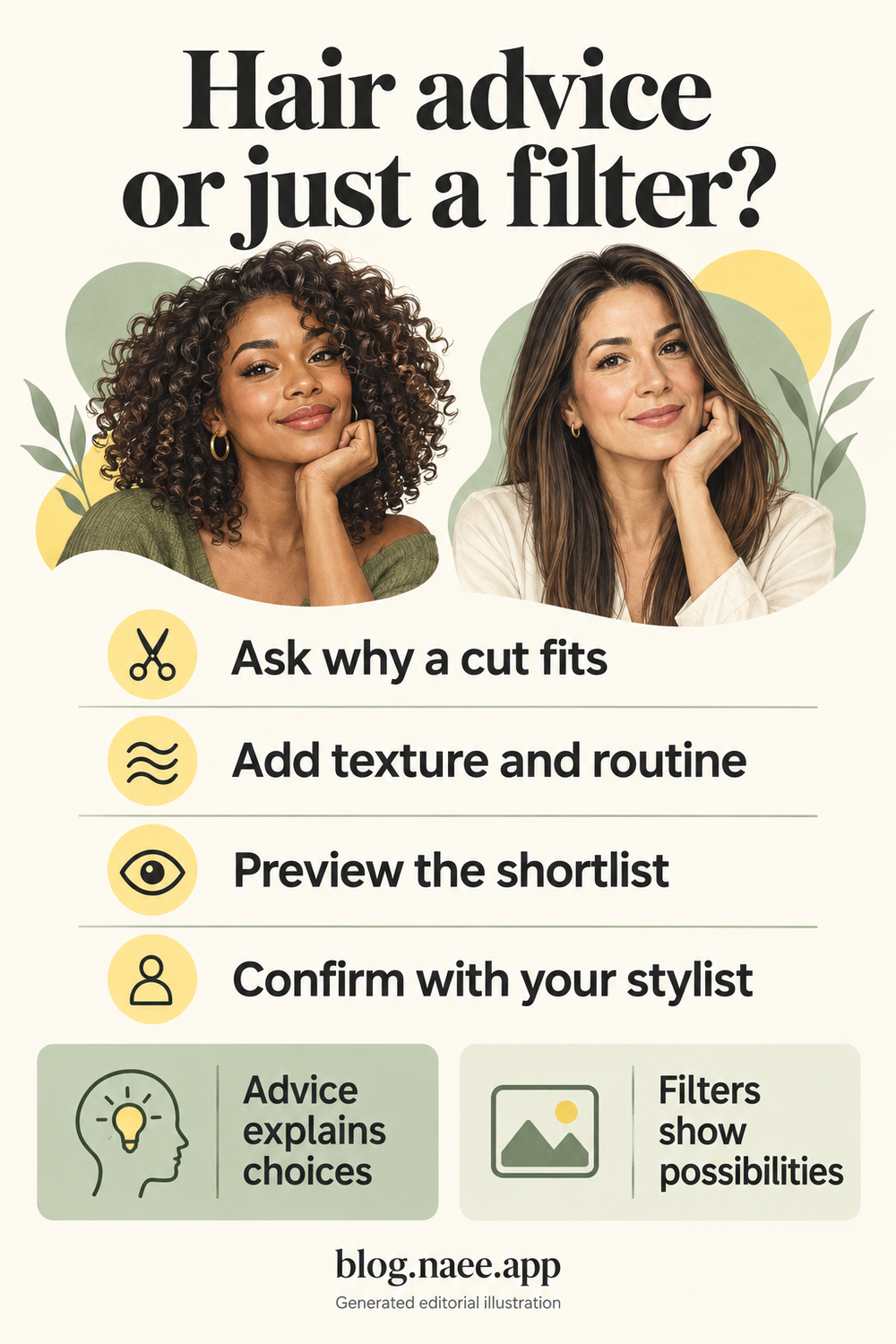
The takeaway: Look for reasoning and visualization, then supply the information neither a face label nor a hair filter can know about your everyday life.
FAQ
Which app suggests haircuts instead of just adding hair to a selfie?
Naee's official listing describes face-shape-based suggestions, Stylist Mode chat, and own-photo hairstyle previews. Those documented features make it an option to investigate. They do not establish a universal best app or independently verified recommendation accuracy. Look for an explanation that uses your preferences and constraints, not only an attractive rendering.
Is AI face-shape analysis enough to choose a haircut?
No. Treat it as one descriptive input. Add natural texture, current length, styling time, tie-back needs, maintenance tolerance, and the effect you personally want. A salon consultation remains important for assessing feasibility on your real hair.
Can Naee measure my hair density or give a validated suitability score?
The official sources cited here describe facial analysis and hairstyle recommendations. They do not establish a verified hair-density detector, medically validated assessment, or measured compatibility score. Supply your own observations about how your hair behaves, and consult an appropriate professional for concerns about hair loss.
What should I ask an AI stylist before generating a preview?
Ask for a small shortlist with reasons, maintenance trade-offs, and assumptions to check. State your texture and routine explicitly. Then choose the options worth visualizing, rather than generating many unrelated looks and hoping a favorite becomes practical.
Does a good hairstyle preview guarantee the salon result?
No. Naee's website explicitly frames previews as exploratory rather than guaranteed in-salon matches. Use the image to communicate a direction, check that your facial features remain recognizable, and ask a stylist how the idea would be adapted to your hair.