
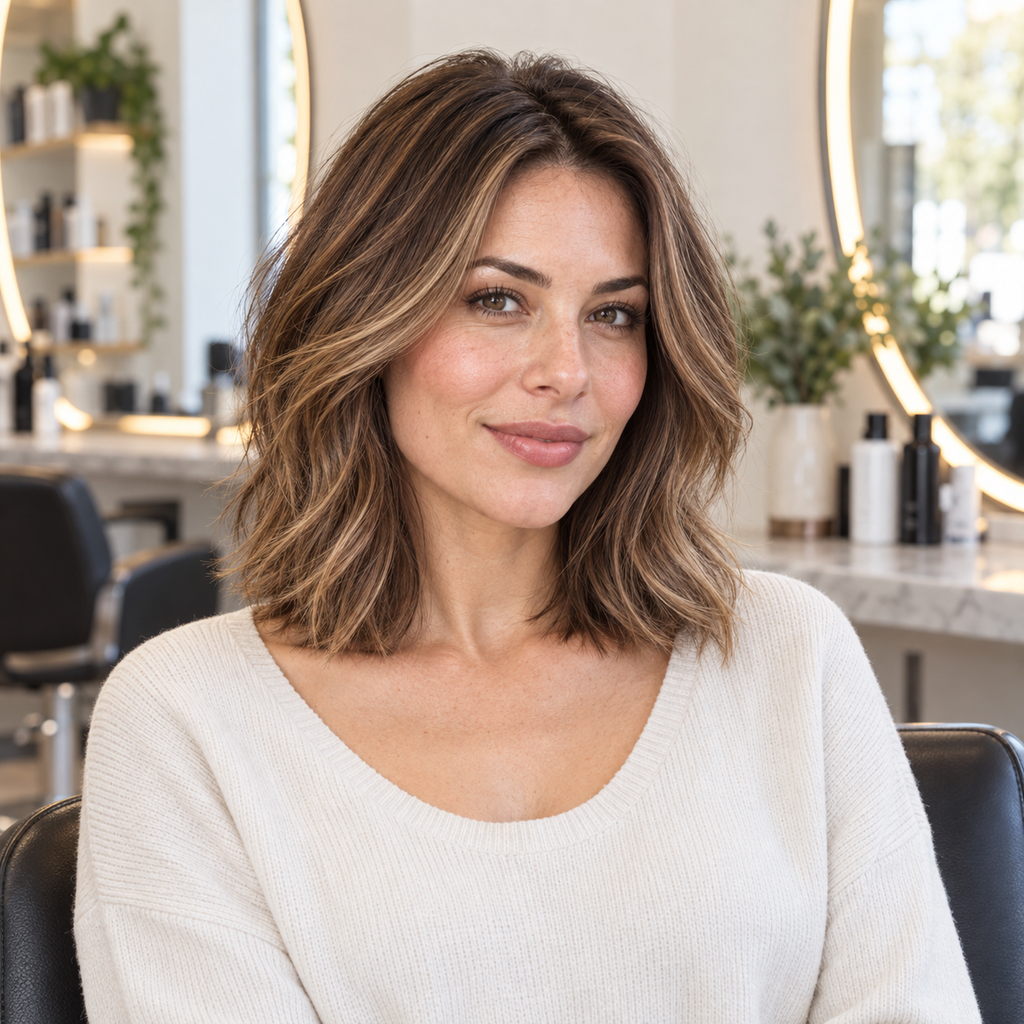
6 Low-Maintenance Medium-Length Haircuts for Your Routine
The best low-maintenance medium-length haircut works with your natural texture and the routine you actually follow. A blunt lob, collarbone cut, long layers, or relaxed shag can each be easy for the right person. None is automatically wash-and-go.
Medium length covers more than one stopping point. Hair can sit near the shoulders, at the collarbone, or a little farther below. Those differences affect whether the ends flip, how much waves rise when dry, and whether the shortest pieces reach your ponytail. Start with six practical options, then use the routine checklist to narrow them down.
Six medium-length haircuts to compare
1. Blunt lob for a clear, fuller-looking edge
A mostly one-length long bob keeps weight at the perimeter. It can be a straightforward option for straight hair and for fine hair whose ends look sparse after too much layering. Ask for the dry length to finish where your hair naturally sits, not simply at the same point as a reference photo.
Maintenance tradeoff: The shape needs little shaping if your hair already falls smoothly, but a sharp edge shows uneven growth. If your waves turn outward at shoulder height, allow that bend or choose a slightly longer baseline instead of planning to straighten it every morning.
2. Collarbone cut for ponytail flexibility
A collarbone cut keeps a little more length than a shoulder-skimming lob. With minimal short face framing, it can give you enough hair for a low ponytail, a claw clip, and a loose bun. Test those functions with your stylist, especially if your texture shrinks as it dries.
Maintenance tradeoff: Extra length may take longer to dry, but it can save daily styling when you need to tie it back. Do not add short crown layers if keeping every section in a ponytail is your main priority.
3. Soft layered lob for natural waves
Long, connected layers can keep a wavy lob from sitting in one heavy block. Ask the stylist to look at where your waves bend and where the sides expand. The aim is to distribute the shape, not to remove as much weight as possible.
Maintenance tradeoff: You may still need a light hold product or a short refresh after sleep. For more detail on layers, shrinkage, and fine versus dense waves, see our haircuts for wavy hair guide.
4. Below-collarbone cut with long layers
If you want movement without giving up the feeling of longer hair, keep the baseline below the collarbone and start the layers low. This can be a useful transition from long hair because you retain length for tying back and avoid committing to a short outline immediately.
Maintenance tradeoff: Long layers blend as they grow, but a round-brush finish in a reference photo will not appear simply because the cut is layered. Choose an air-dried reference if that is how you plan to wear it.
5. Relaxed medium shag for visible texture
A shag uses more obvious layers to create a less uniform outline. It is worth considering if your waves already separate into a shape you like and you enjoy a tousled finish. Ask for a version with enough length at the crown and around the face to fit your routine.
Maintenance tradeoff: A shag is not the default easy cut for everyone. Very fine or low-density ends can become too light, and a short fringe may need daily attention. Skip the fringe if that extra task cancels out the benefit.
6. Rounded medium cut for curls and coils
A rounded shape distributes volume around the head rather than leaving all the weight at the bottom. A texture-experienced stylist can plan the finished dry length and adjust individual sections so the silhouette fits your curl pattern.
Maintenance tradeoff: A good shape does not replace your wash, detangling, or refresh routine. Explain how you usually wear your curls and whether you need to switch between loose hair and tied-back styles.
Define low maintenance before choosing the cut
Ask what you mean by easy. You may want to:
- Wash and air-dry without a round-brush blowout
- Put your hair into a secure ponytail or bun
- Spend five minutes refreshing the front on workdays
- Stretch the time between trims
- Keep enough length to change your part or wear a clip
- Avoid a fringe that needs daily shaping
These goals can conflict. A precise blunt line may be simple to style but show shoulder flipping clearly. Long layers may disguise an uneven grow-out but reduce how securely your hair ties back. A fringe can make the overall cut feel finished while adding a separate trim and styling task.
Write down your ordinary routine before you show a stylist a reference photo. “Low maintenance” should describe your life, not the model's salon finish.
Start with your natural texture
Straight hair
Straight hair shows the perimeter clearly. A mostly one-length lob or shoulder cut can look polished with little styling, especially when the ends are healthy. A small amount of face framing can keep it from feeling heavy without creating many pieces to manage.
If your hair flips at the shoulders, ask whether the baseline should sit slightly above or below that point. A few extra centimeters can change an outward kick into a smoother line, but the best length depends on your neck, shoulder slope, and the way your hair dries.
Wavy hair
Waves can make a shoulder cut look intentionally undone, but the final length may rise as the pattern dries. Ask for the shape to be designed around your usual wave pattern rather than a straightened reference. Long layers can encourage movement, while too many short layers may create a wider outline or pieces that need reshaping.
A useful air-dry plan might be a gentle leave-in, scrunching, and hands-off drying. If you do not want to use product, tell your stylist. The cut should not depend on a styling step you will skip.
Curly and coily hair
Curly and coily hair need a texture-aware consultation. Shoulder length may look considerably shorter when dry because of shrinkage, and the balance of volume can change between wash days. Discuss whether you want width at the sides, more height, or a rounded shape before choosing where the perimeter should fall.
Ask how the cut will look at its fullest and how much length remains for a ponytail. A stylist can also explain whether the shape is easier to maintain with your curls dry, stretched, or in their usual wet-to-dry routine.
Decide how important a ponytail is
Shoulder-length hair can usually be tied back, but not every shoulder cut makes a secure ponytail. Face-framing pieces, a short nape, layers around the crown, and curly shrinkage can leave loose sections.
If you need a ponytail for exercise, work, or sleep, bring that requirement to the appointment. Ask for:
- Enough length at the nape to reach your preferred tie
- Front pieces that can tuck behind your ears or join the ponytail
- Layers that do not fall into your eyes immediately
- A shape that still looks good when the ponytail is not perfectly tight
A low ponytail may work before a high one. Try the elastic and placement you use at home rather than assuming “shoulder length” guarantees every updo.
Plan for the shoulder flip
The point where hair meets the shoulders creates friction. Ends may turn outward, bend under, or separate into several directions. This is not automatically a styling failure, but it should be part of the decision.
You have several options:
- Finish above the shoulder. A shorter bob can avoid the contact point, though it may require more frequent trims and offer less tying-back flexibility.
- Move past the shoulder. A collarbone-length lob can place the ends below the strongest bend and preserve more movement.
- Use the bend deliberately. Soft waves and light layers can make the flip look intentional instead of trying to flatten it.
- Keep a quick reset. A few minutes with a brush, diffuser, or large clip may be realistic if you enjoy styling occasionally.
Dense hair may need internal weight adjusted so the ends do not push outward. Fine or low-density hair may need a stronger perimeter so the ends do not look separated. Fine hair and low density are different concerns, so describe both to your stylist. Our guide to haircuts for women with thinning hair explains why preserving the perimeter can matter when density has changed.
Choose fringe with its upkeep included
Fringe changes the maintenance plan more than a small length adjustment. A full fringe often needs regular shaping and may need to be reset after sleep. Curtain bangs offer more flexibility as they grow, but they still need a part and face-framing direction that suits your hairline. A side-swept fringe can be a lighter commitment when you want movement near the forehead.
Consider your cowlick, sweat, glasses, and willingness to wash or restyle the front. Ask whether the fringe can be pinned back or blended into the haircut during grow-out. If you air-dry, request a version that is designed to separate naturally instead of requiring a daily round-brush finish.
Make the cut work for your density
- Fine, dense hair: A clean perimeter with a few long layers can provide movement without making the ends look wispy.
- Low-density hair: Preserve as much visual weight as possible. A mostly one-length shoulder cut may look stronger than many short layers.
- Thick or dense hair: Internal weight removal can keep the shape from becoming triangular or overly wide, but the method should suit your texture.
- Mixed texture: Explain where your hair changes pattern. A uniform reference photo may need different lengths on different sections.
For more context on how texture, density, and face proportions work together, read how to choose hairstyles by face shape. Face shape can suggest a silhouette, but it does not decide the maintenance level.
Think about grow-out before the first cut
Shoulder cuts are easier to live with when you know what happens after the first appointment. Ask:
- Where will the shortest layer be in six to eight weeks?
- Can the shape become a collarbone lob without another major cut?
- Will the fringe blend into the sides?
- How will the nape look if I skip one trim?
- Which parts can I clip, tuck, or tie during the awkward stage?
A softer outline, longer face framing, and fewer high-contrast layers generally give you more styling options as the hair grows. A sharply graduated bob or short fringe may look excellent but show change sooner. Neither is wrong. Choose the upkeep you are willing to schedule.
What to ask your stylist
Bring a reference photo with a similar texture and explain the parts you want to keep. Useful questions include:
- “How will this shape look when I air-dry it with my normal part?”
- “Will the ends sit above, on, or below my shoulder?”
- “Can I still make my usual ponytail?”
- “How much layering can my density support?”
- “What will the cut look like as it grows for two months?”
- “How often would you recommend a trim for this outline?”
The hairstyles for women over 40 guide also has routine-first questions that apply at any age. There is no age-based length rule; the useful choice is the one that fits your hair and your schedule.
Preview the silhouette before you commit
Naee can help you compare a shoulder cut, collarbone lob, and shorter bob on your own photo. Try to compare the outline first, then test a fringe or part separately. A preview shows a visual direction, not how your hair will move, shrink, or flip after a real cut. Save two or three options and ask a stylist to adapt them to your texture and density.
Download Naee for iPhone (free download, in-app purchases) →
FAQ
Is shoulder-length hair low maintenance?
It can be, when the shape matches your texture and routine. A mostly one-length cut or long-layered lob may air-dry easily, while a precise fringe or strongly graduated shape can need more frequent styling and trims.
How do I stop shoulder-length hair from flipping out?
You can place the ends above or below the main shoulder contact point, use the natural flip as part of the shape, or reset the ends with a quick styling step. Ask your stylist how the cut will behave on your shoulders rather than relying on a straightened photo.
Can shoulder-length hair go into a ponytail?
Often, but the result depends on your texture, shrinkage, layers, and nape length. Tell your stylist how you wear your ponytail and test the tie at the appointment if that function is important.
Is a fringe low maintenance with shoulder-length hair?
A longer curtain or side-swept fringe can be more flexible than a short full fringe, but every fringe adds some upkeep. Consider your hairline, cowlicks, air-dry routine, and tolerance for regular trims.
How often should a shoulder-length haircut be trimmed?
The timing depends on the shape and how much change you notice as it grows. A sharp perimeter, fringe, or short layers usually show growth sooner than a softer lob with longer framing. Ask your stylist for a schedule based on your chosen outline.
Choose your normal-day version
Shoulder length works best when you decide what “easy” means first. Choose the texture plan, ponytail function, shoulder position, fringe commitment, and grow-out path together. Then take a short list to your stylist and ask how each option behaves without the salon finish.