
Hairstyles for Diamond Faces: Frame or Show Your Cheekbones
Start by choosing whether you want to frame your cheekbones or show them. Hairstyles for diamond faces can include a rounded chin bob, softly waved lob, side-swept fringe, textured pixie, longer framing or an open-forehead style. The useful differences are where the shortest pieces end, where the hair is widest and how much styling the outline needs, not whether a haircut follows a face-shape rule.
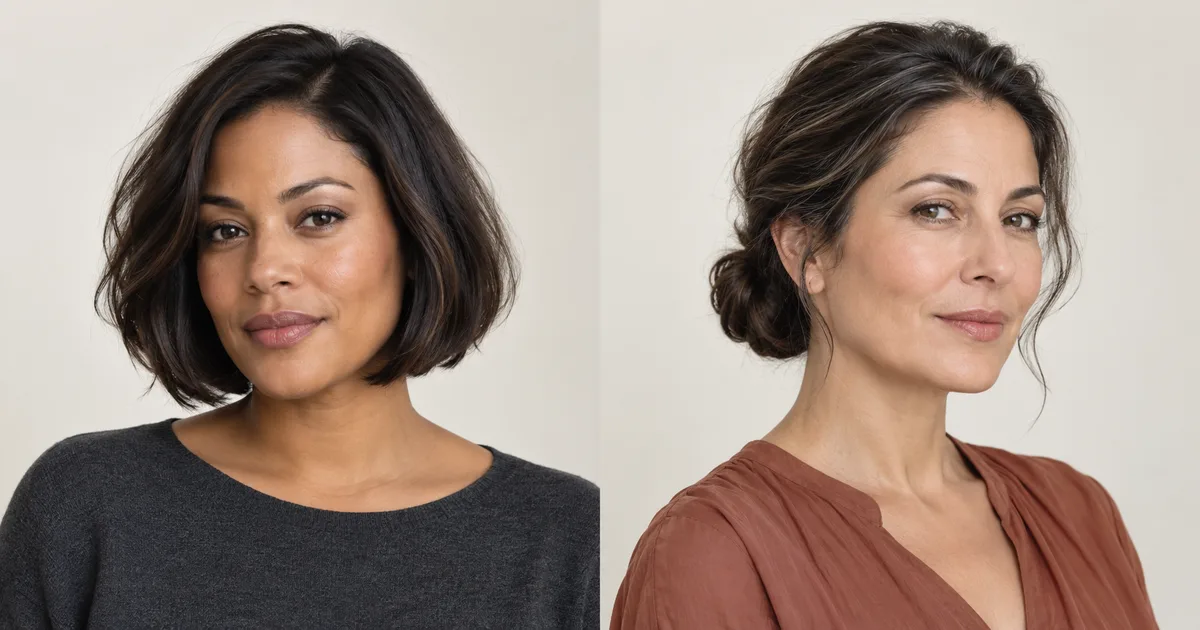
Generated editorial illustration of two different hairstyle choices, not Naee output or a real transformation.
Your cheekbones are not a flaw to hide. A frame can bring softness around them; swept-back hair can make them the focal point. You can enjoy both on different days. This guide goes beyond naming suitable cuts and explains how to choose their actual endpoints, side volume and everyday finish.
Contents
- Use face-shape labels lightly
- Hairstyles for diamond faces: seven directions to compare
- Place side volume and choose your shortest piece
- Adapt the silhouette to texture, density and routine
- Compare two ideas and build a salon brief
- FAQ
Use face-shape labels lightly
In conventional styling language, a diamond shape has its broadest area around the cheekbones, with a relatively narrower forehead and jaw. A heart shape usually has a broader forehead that tapers toward the chin. An oval description emphasizes a gently elongated outline and softer transitions rather than one strongly widest central area.
These are qualitative descriptions, not diagnoses or biometric measurements. A hairstyle, camera angle or close selfie can change the visible outline. Many people recognize parts of two descriptions, and a pointed chin alone does not settle the category. If your face looks oval in one photo and diamond-like in another, you do not need to resolve that before choosing a cut.
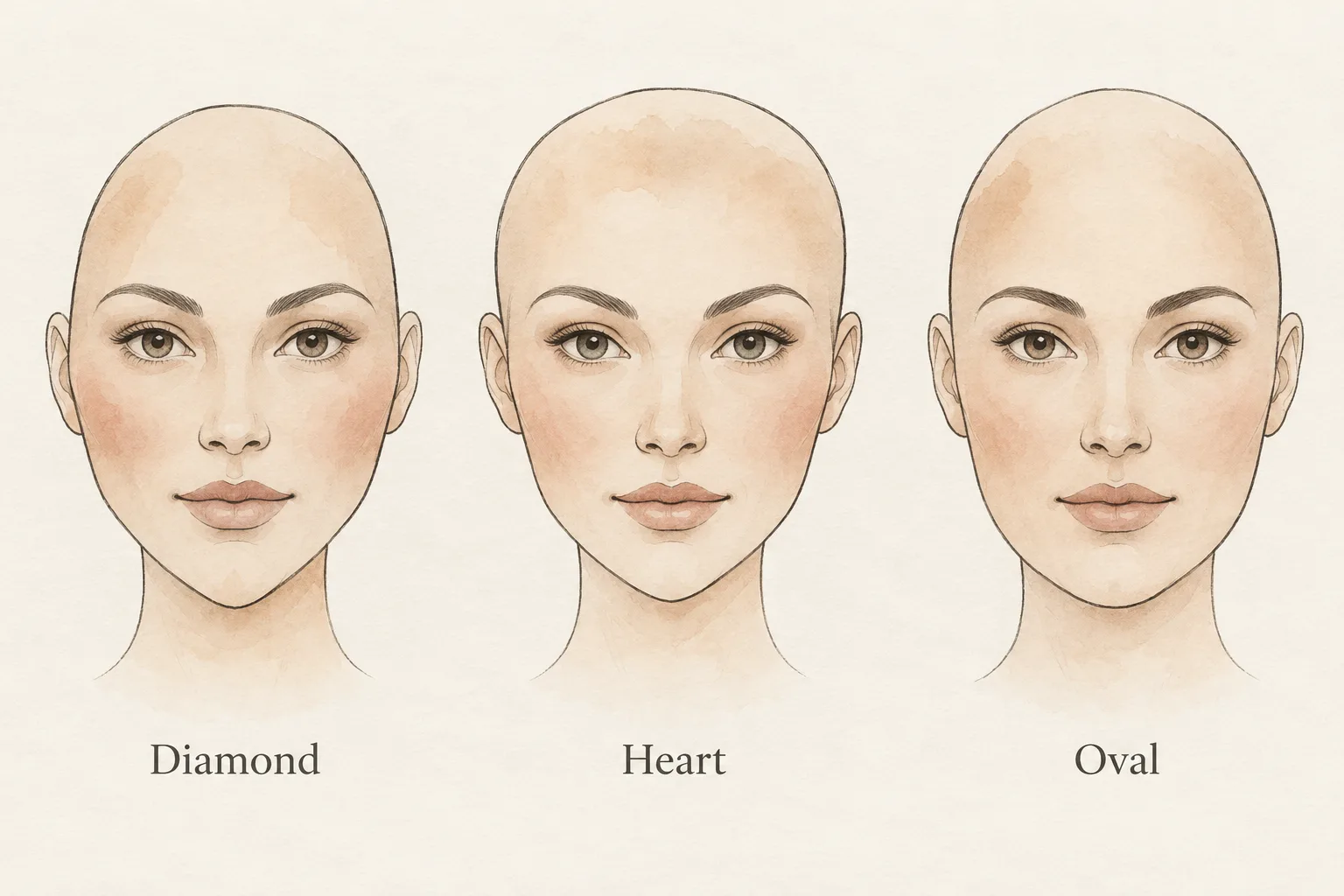
Generated editorial proportion diagram, not Naee output, a facial analysis or a measurement of a real person.
Look in a level mirror with the hair gently moved away from the face. Notice whether you want more hair around your forehead, more movement near your jaw, or a clearer view of your cheekbones. Those observations are more useful than assigning yourself a perfect label. Our broader hairstyles by face shape guide explains the categories; the oval-face hairstyle guide can offer additional ideas if both descriptions feel relevant.
Sources do not even agree on blanket rules. The salon's own Becky B diamond-face guide recommends side-swept fringe and chin bobs but discourages center parts. The official Davines diamond-face article favors center parts and discourages chin-length cuts. Treat those positions as aesthetic preferences, not evidence that a part or length is forbidden.
In British Vogue's stylist interviews, Pete Burkill describes the decision as celebrating structure rather than correcting it. He also emphasizes texture, density, hairline and styling time. That is the approach here: describe the effect, decide whether you want it, then check whether it works with your hair.
Hairstyles for diamond faces: seven directions to compare
Each direction below answers a different visual question. You do not need to combine all of them. Begin with one length and one framing preference so that you can identify what you actually like.
Rounded chin bob
A softly rounded bob places its perimeter near the chin, bringing a visible curve to the lower frame. The important detail is the dry endpoint, not the word “bob.” A chin bob with underturned ends looks different from a straight-edged bob or a version tucked behind both ears.

Generated editorial illustration showing a chin endpoint and curved perimeter, not Naee output or an actual haircut result.
Ask for an outline that sits near your preferred chin point when dry, and discuss how much rounding comes from the cut versus the finish. Fine ends may need a more connected perimeter rather than many short layers; dense hair may need a different distribution of weight. An underturned salon photograph does not prove your hair will turn inward after air-drying.
If you want a strong straight line instead, say so. A blunt bob is an intentional graphic choice, not automatically wrong for prominent cheekbones. The bob guide for fine hair explains why perimeter and layering decisions need their own conversation.
Softly waved lob
A collarbone lob keeps a longer frame while adding movement through the sides. A wave can create fullness near the jaw or make a diagonal transition past the cheeks. Where that bend falls matters more than whether the reference is called “beach waves.”
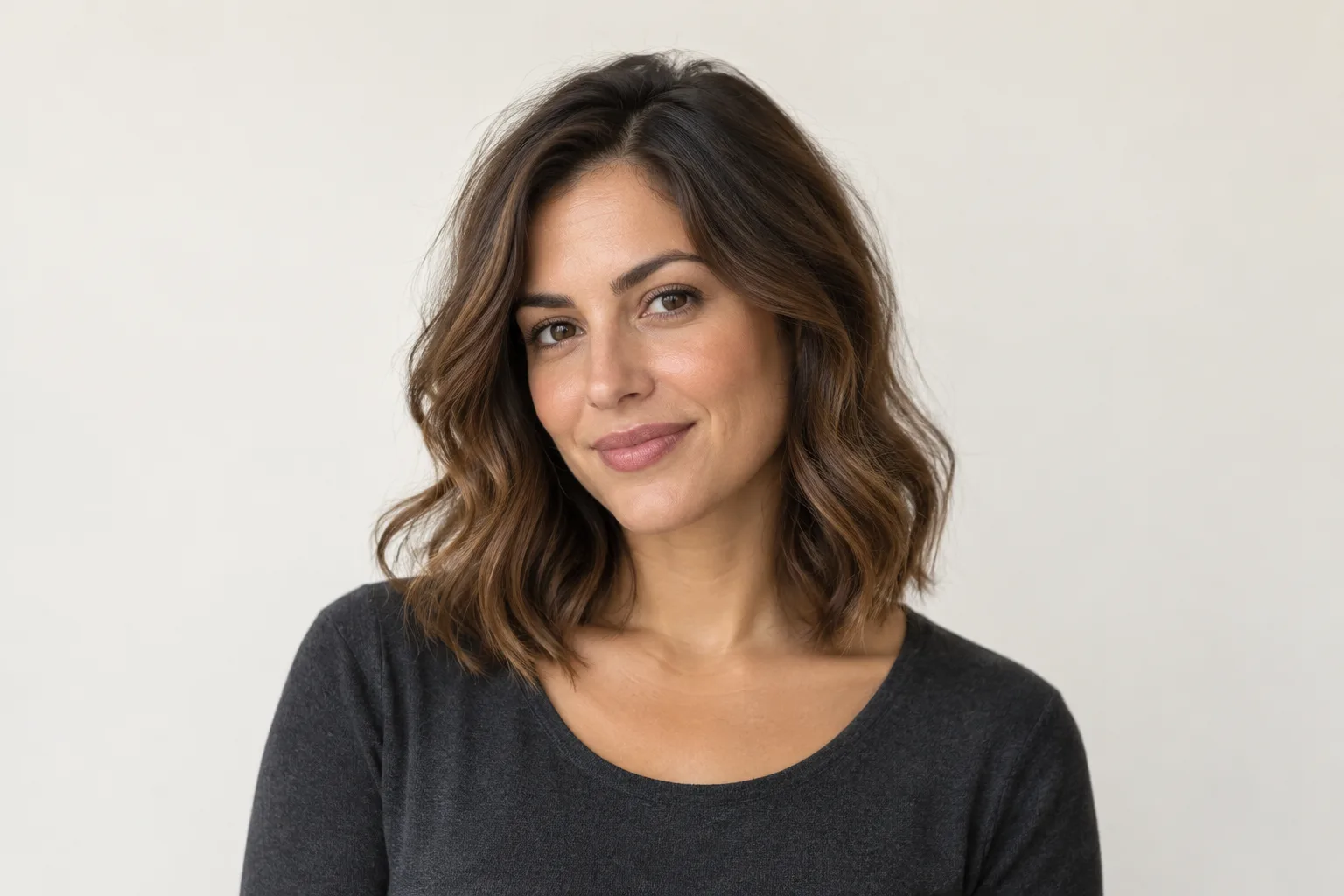
Generated editorial illustration of a softly waved lob, not Naee output or a predicted air-dry result.
Ask your stylist to show the intended collarbone endpoint with your natural wave, and specify whether you prefer a quieter cheek area or fullness there. If your hair is straight, the pictured waves may require a separate styling routine. If it already waves, the ends may sit higher when dry and touch the shoulders differently. Our haircuts for wavy hair guide helps separate a haircut's shape from the finish in its reference photo.
A lob can retain more practical length than a chin bob, but do not assume every front section will join a ponytail. Check the shortest pieces, not just the longest ends.
Side-swept fringe
A side fringe adds a diagonal line across part of the forehead. Depending on its length, it can create softness near the temple while leaving the cheekbone visible. It changes the upper frame without requiring you to shorten the whole haircut.
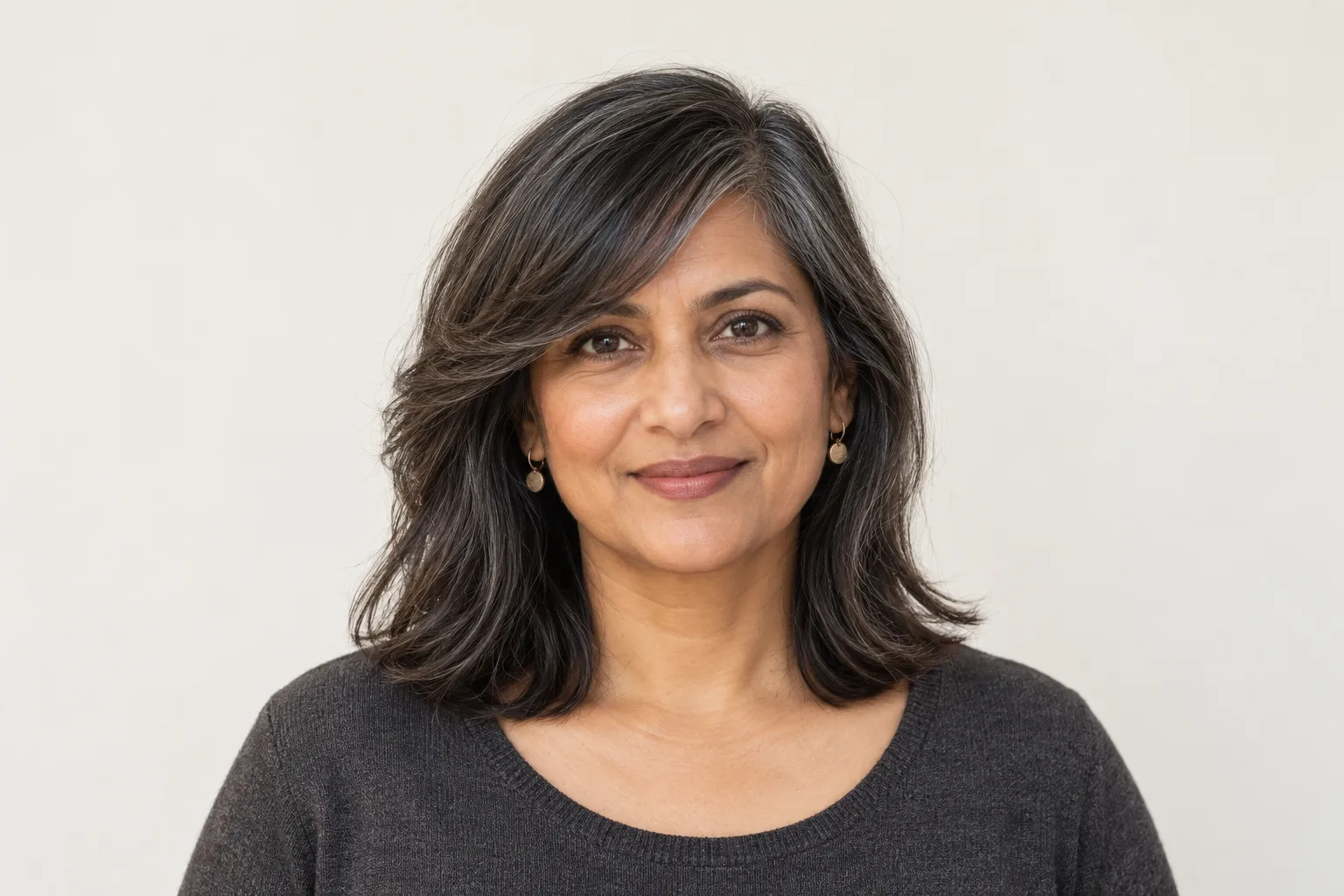
Generated editorial illustration of side-swept fringe, not Naee output or a real transformation.
Specify where the fringe should finish when dry and whether it must tuck behind an ear. “Soft bangs” is not enough: an outer-eye endpoint has a different practical commitment from a cheek- or jaw-length section. Show your usual part, glasses and any front cowlick during the consultation.
The limitation is daily placement. A fringe that falls neatly to one side in a photograph may split, lift or fall into your eyes on your own hair. Ask how to reset it with the tools you already use, and what it looks like if you do nothing. A longer frame may be a better choice if you dislike managing front pieces.
Open forehead and swept-back hair
Leaving the forehead and temples open deliberately emphasizes the face rather than enclosing it. A loose sweep, an ear tuck or a low bun can show cheekbones clearly. You do not need to “balance them out” if showing them is your goal.
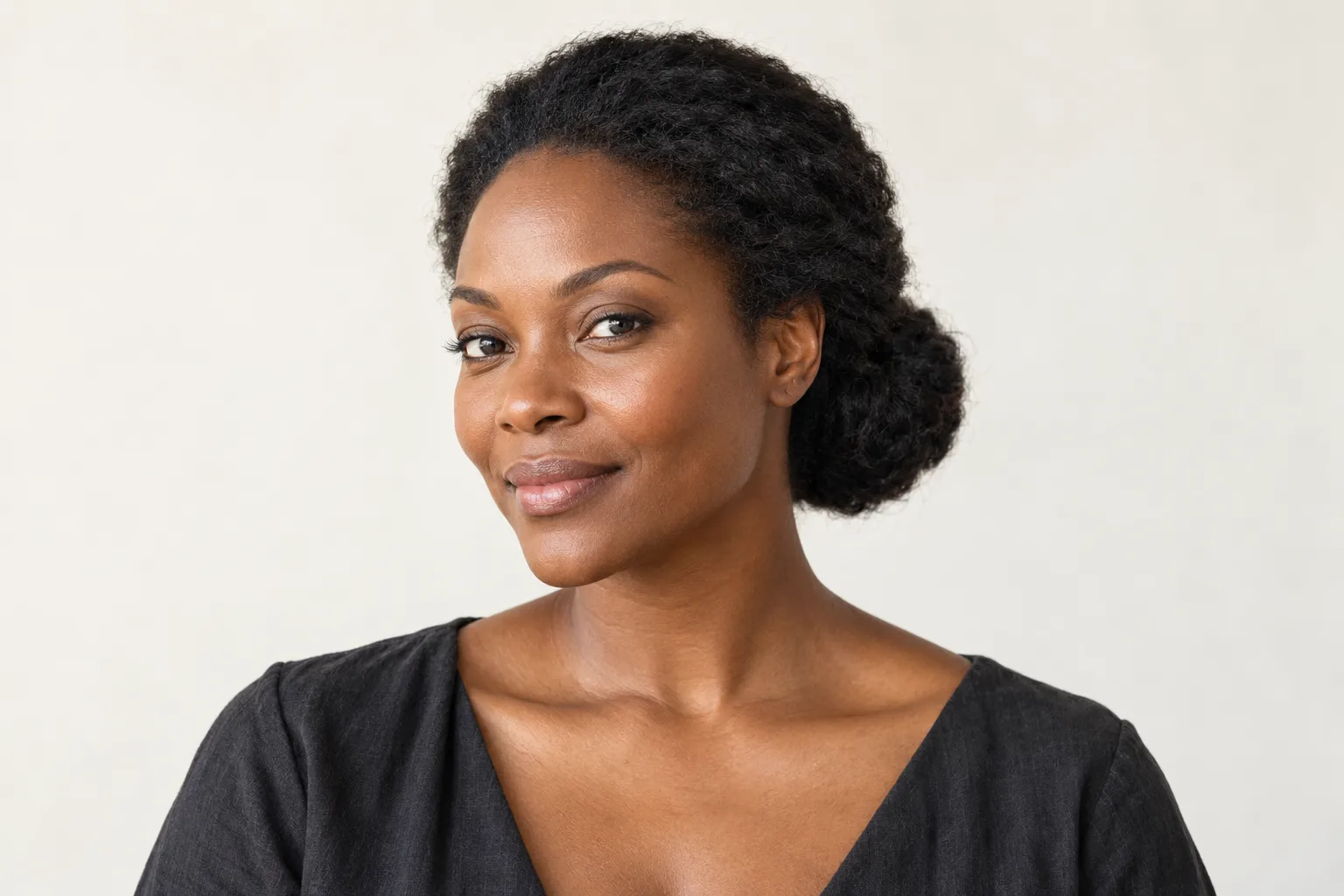
Generated editorial illustration of an open-forehead styling option, not Naee output or a real transformation.
Try this direction with your current hair before changing the cut: loosely move the front back and look at the result without pulling it tightly. Decide whether you like a fully open frame or a few loose pieces at the temples. This is a styling choice, so it can coexist with a lob or longer layers.
If you want to keep that option after a haircut, check that the relevant front and nape sections remain long enough to secure comfortably. A low bun needs sufficient length; a pixie can reveal the same facial areas without offering the same tied-back style. Neither requires a new face shape.
Pixie with temple softness
A pixie can leave the cheekbones exposed while keeping small, soft sections at the temples. The contrast comes from short overall length and a more textured upper frame, not from a requirement to add dramatic height.

Generated editorial illustration of a pixie with temple softness, not Naee output or an actual haircut result.
Ask how much coverage remains around the temples and ears, what the nape looks like, and which direction the top naturally falls. “Keep the cheekbones visible but retain airy temple pieces” gives a clearer brief than “a flattering pixie.” A very close side and a soft side have different effects even at the same overall length.
Short hair does not automatically mean no maintenance. Keeping a precise crop may require trims, and a textured top may still need resetting after sleep. Our should I cut my hair short guide helps weigh the change against your routine rather than treating face shape as permission.
Longer framing below the cheekbones
If you like your cheekbones visible but want hair around the lower face, consider a shortest frame around the jaw or below it. The front then travels diagonally into longer lengths rather than placing a short edge directly beside the cheek.
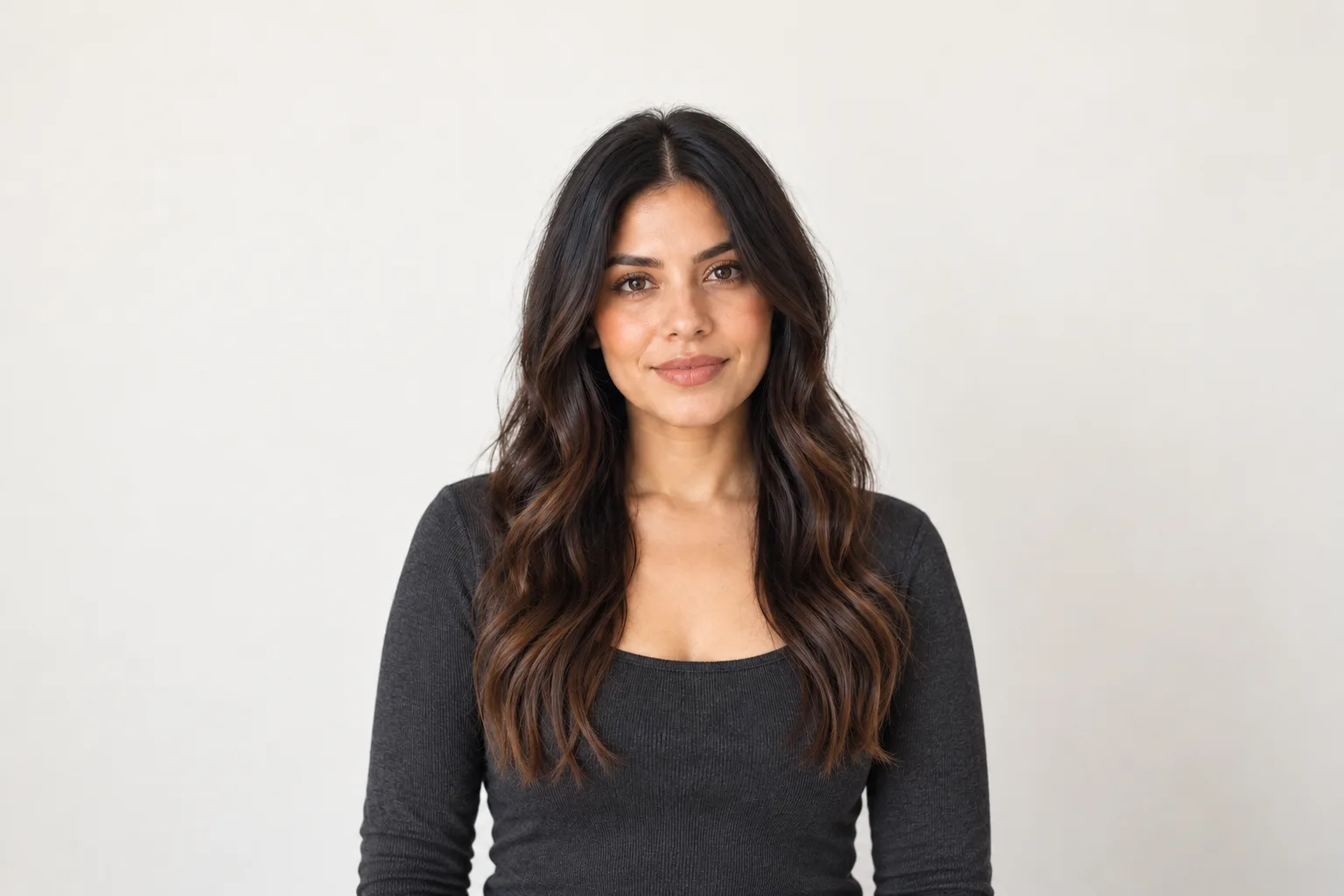
Generated editorial illustration with below-cheekbone framing, not Naee output or a real transformation.
Choose the shortest dry endpoint first. Then decide whether you want a few quiet front pieces or connected layers throughout the haircut. The face-framing layers guide explains those distinctions. A center part is a valid way to show the two sides of that frame; it is not a banned option.
The practical limit is how the short pieces behave when you tuck or tie them back. A jaw-length front can fall out of a ponytail even when the rest reaches your chest. Long hair also does not guarantee effortless movement: the illustrated bend may reflect styling rather than the cut alone.
Naturally curly and coily shape
Curls and coils offer their own framing possibilities. A rounded silhouette can carry volume through the temples and lower sides while leaving the cheekbones partly visible. You can also enjoy a wider cheek-level shape if that is the outline you prefer.
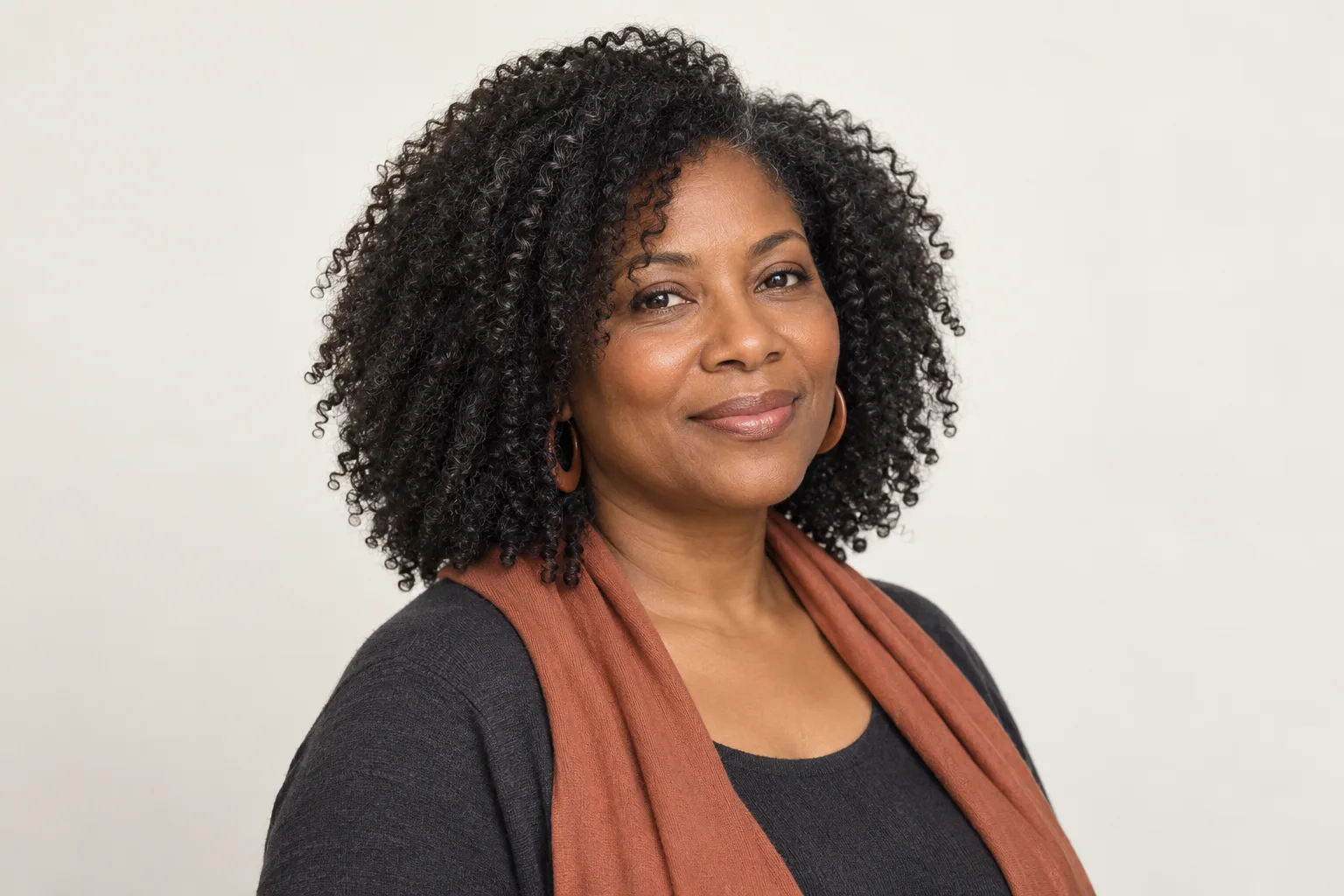
Generated editorial illustration of a naturally coily silhouette, not Naee output or a promise of this curl pattern or density.
Show your stylist your usual dry shape and how it changes between wash days. Describe the region where you want the hair to feel fullest, rather than requesting straight-hair layer lengths copied literally onto coils. Ask where the shortest curl will sit in its normal dry state and what can remain secured when needed.
Shrinkage and varying curl patterns make one wet endpoint an incomplete guide. The amount of visible fullness also depends on your real density and how you separate or define your texture. Keep the natural pattern you enjoy; there is no need to straighten it to satisfy a diamond-face recommendation.
Place side volume and choose your shortest piece
Length, fringe and side volume are separate controls. A shoulder cut can be narrow at the cheeks and full near the jaw, or full at the cheeks with a quieter lower outline. Neither is inherently better. Choose where you want the visual attention to land.
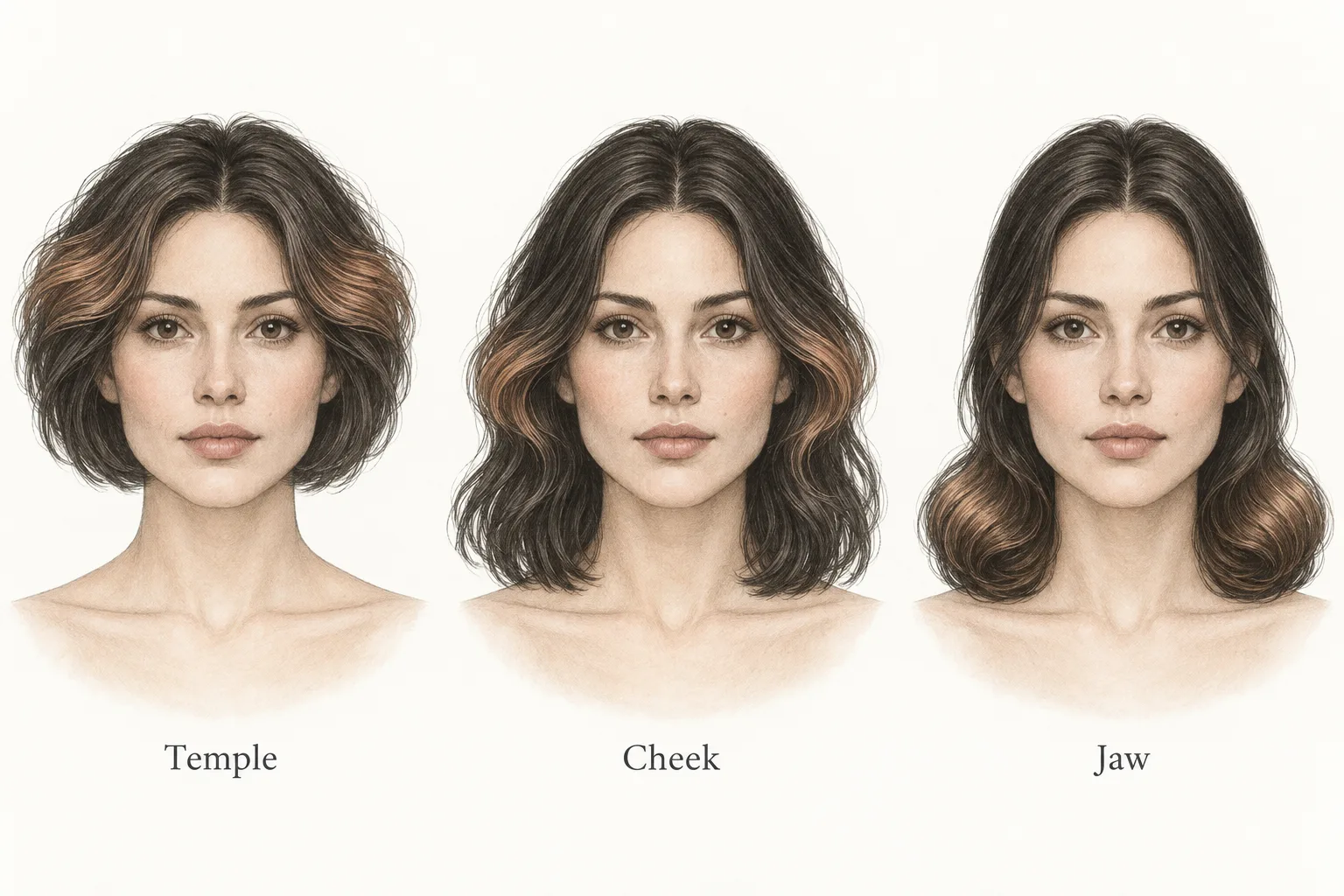
Generated editorial concept figure, not Naee output, a biometric analysis or a best-to-worst ranking.
Use this comparison when choosing two references:
| Your preferred effect | A direction to compare | Specific question for the stylist | Important limitation |
|---|---|---|---|
| A softer upper frame | Side fringe or airy temple pieces | Where will the shortest piece fall when dry? | Growth direction may move the piece away from its pictured position |
| A rounded lower frame | Chin bob or jaw-level wave | Can the perimeter sit here without daily underturning? | The pictured curve may come from styling |
| More cheekbone emphasis | Open forehead, ear tuck or swept-back hair | Can I keep the face open without a tight style? | A bun or tuck requires usable length in the relevant sections |
| Movement below the cheeks | Longer frame starting around the jaw | Which pieces will still tuck or join a ponytail? | Long overall length does not make every layer tie-back length |
| A bold cheek-level silhouette | Fuller curls or a wave bend beside the cheeks | Can we place fullness here with my natural texture? | Reference density and curl pattern may not match yours |
A common mistake is combining a fringe from one photograph, cheek-level volume from another and a perimeter from a third, then expecting the result to behave like all three. Select one complete silhouette first. Adjust only the feature that matters most to you.
Another mistake is treating cheek-level width as universally unwanted. If you like a bold rounded frame, choose it knowingly. If you want a quieter center and more movement near the jaw, ask for that instead. The decision is about preference, not concealment.
Adapt the silhouette to texture, density and routine
The same length can make different outlines on different hair. Fine strands and low density are not interchangeable: one describes strand diameter, the other the amount of hair. A generated image cannot establish either from a flattering silhouette.
With fine-looking or sparse ends, ask whether fewer front layers would retain the perimeter you want. With dense hair, ask how the weight can be distributed without automatically removing the fullness you enjoy. Our fine-hair hairstyle guide explores that perimeter-versus-layering decision separately.
For straight hair, check whether the outline depends on curled ends or root lift. For waves, compare the dry bend and shoulder contact rather than a stretched length. For curls and coils, discuss the usual dry shape and variation across sections. These questions prevent a style name from hiding the work behind its photograph.
Bring your routine into the decision early:
- Do you air-dry, diffuse, blow-dry or alternate between them?
- Do glasses or earbuds interfere with the front pieces?
- Must the hair tuck, clip or tie back for work or exercise?
- What tools do you actually own and want to use?
- Are you comfortable refreshing a fringe separately?
- How often are you willing to maintain the outline with trims?
“Low maintenance” only means something when attached to a routine. Ask the stylist to describe the simplest version of the cut on your hair and the polished version separately. If the reference requires styling you do not want, choose a less dramatic finish rather than assuming the salon result will persist by itself.
Compare two ideas and build a salon brief
Publisher disclosure: This is the Naee blog, and we have a commercial interest in the app. The images in this article are original generated editorial illustrations, not observed Naee outputs. We have not conducted an independent diamond-face accuracy or haircut-feasibility test.
The official Naee website describes own-photo hairstyle previews, copying style cues from a reference and saving favorites. Its own accuracy guidance says previews are not guaranteed exact matches to salon results. The current App Store listing describes face-shape suggestions and Stylist Mode, but those descriptions do not validate a face-shape diagnosis, density measurement or compatibility score.
If a visual preview would help, use one clear, evenly lit source photo and compare two specific directions. Keep the color and apparent texture similar so that a new shade or polished finish does not distract from the framing question. Check that the forehead, cheekbones, jaw, eyes and nose still resemble the source before using the image to judge the haircut. Our AI hairstyle face-preservation checklist and face-shape hairstyle app guide explain that limitation in more detail.
Hypothetical example, not a real user result: Imagine Leila, who has naturally wavy shoulder-length hair, wears glasses and wants to keep her cheekbones visible. She has ten minutes for her usual morning routine and needs the front to clip back. She compares a rounded chin bob with a collarbone lob whose shortest frame finishes at the jaw.
The bob image appeals to her because of its clean lower curve, but she notes that the illustration is underturned and asks whether that shape would need a blow-dry. The lob retains more length, but she checks whether its jaw pieces can reach her clip. She is not comparing which picture “fixes” her face. She is comparing an endpoint, a finish and a practical requirement.
Her salon brief could read:
“I want my cheekbones visible with a softer line near the jaw. I like this collarbone endpoint and jaw-length frame, but I need the front to clip back. Please show me how the idea would sit in my normal waves without assuming the illustrated volume.”
Bring the original photo alongside any generated references. Mark keep for the framing effect you like, change for a length or fringe you want adjusted, and check for uncertain texture, added density or styling. A stylist can assess your actual growth pattern and hair behavior in a way a generated picture cannot.
If you want to explore these two directions, you can download Naee for iPhone. The download is free, with limited trial credits; continued generation requires a subscription or credit purchase according to the listing checked October 11, 2026. Check the current in-app allowance and purchase terms before planning multiple variations.
The takeaway: Choose whether you want framing, emphasis or the flexibility to do both. Then choose the dry endpoint and side-volume placement that fit your real hair and routine. Your face-shape label is a starting description, not the final decision.
FAQ
What hairstyle works for a diamond-shaped face?
Compare a rounded chin bob, waved lob, side fringe, soft pixie, longer frame or naturally curly shape according to the effect you want. An open-forehead style is also a valid choice when you want to emphasize cheekbones. There is no single best cut independent of texture, density and styling routine.
Can a diamond face wear a center part?
Yes. A center part can show a symmetrical frame or leave a clearer opening around the face. Published guides disagree about whether to favor it, which is a reason not to treat their preferences as bans. Compare it with a side part on your own hair and notice where the front pieces sit.
Are bangs necessary for diamond faces?
No. A side fringe adds a diagonal upper frame, while an open forehead emphasizes your features differently. Choose bangs only if you like their appearance and are comfortable managing their dry endpoint, growth direction and daily placement. Longer framing can provide another option without a short fringe.
Is short hair suitable for a diamond face?
Yes. A chin bob and a pixie offer different ways to frame or reveal the face. Specify temple coverage, ear exposure and the dry perimeter rather than choosing from the word “short” alone. Also consider the trimming and styling needed to maintain the version you want.
Can an AI preview tell me which cut will work on my hair?
It can help you communicate a silhouette preference, but it cannot establish how your actual density, curl pattern or growth direction will support the cut. Inspect facial changes and invented fullness, then ask a stylist about feasibility. Treat a face-shape suggestion as a prompt for discussion, not a measurement or guarantee.